- November 18, 2026
- Admin Quantal AI
Overview
Not every Python developer can build production of AI systems. When you hire python developers for AI to work, look for hands-on experience with machine learning frameworks, retrieval-augmented generation (RAG), model deployment, and monitoring. Ask candidates to explain AI systems they have launched and maintained, not just prototypes or notebook projects.
Introduction
Python is widely used for artificial intelligence (AI), but not every Python developer has the skills to build AI systems. Many focus on websites, APIs, and backend applications. AI projects need extra knowledge of machine learning (ML), data pipelines, and model deployment.
When businesses plan a python developer to hire without checking these skills, they risk delays and costly rework. At Quantal AI, we recommend checking real project experience, testing practical skills, and defining the work before making a hiring decision. This guide explains what to look for and how to assess candidates.
Key Takeaways
- Python web development and production AI engineering require different skills.
- Look for experience with ML frameworks, RAG pipelines, data engineering, and cloud deployment.
- Ask candidates about real systems they have launched, monitored, and improved.
- A paid trial task can reveal coding quality, communication, and problem-solving skills.
- Hiring costs depend on experience, location, and the AI work involved.
DEFINITION BOXES
What Is a Python AI Developer?
A python ai developer uses Python to build AI features and systems. Their work may include training machine learning models, connecting large language models (LLMs) to applications, and preparing data for AI tasks. This differs from general Python development, which often focuses on websites and backend services.
What Is Production AI Experience?
Production AI experience means deploying an AI system for real users and maintaining it after launch. It includes tracking accuracy, response time, data quality, and operating costs.
What Is a RAG Pipeline?
Retrieval-augmented generation (RAG) connects an AI language model to relevant documents or business data. It retrieves useful information before generating an answer. This can help an AI application use company-specific information.
Python for AI vs Python for Web: Why the Difference Matters
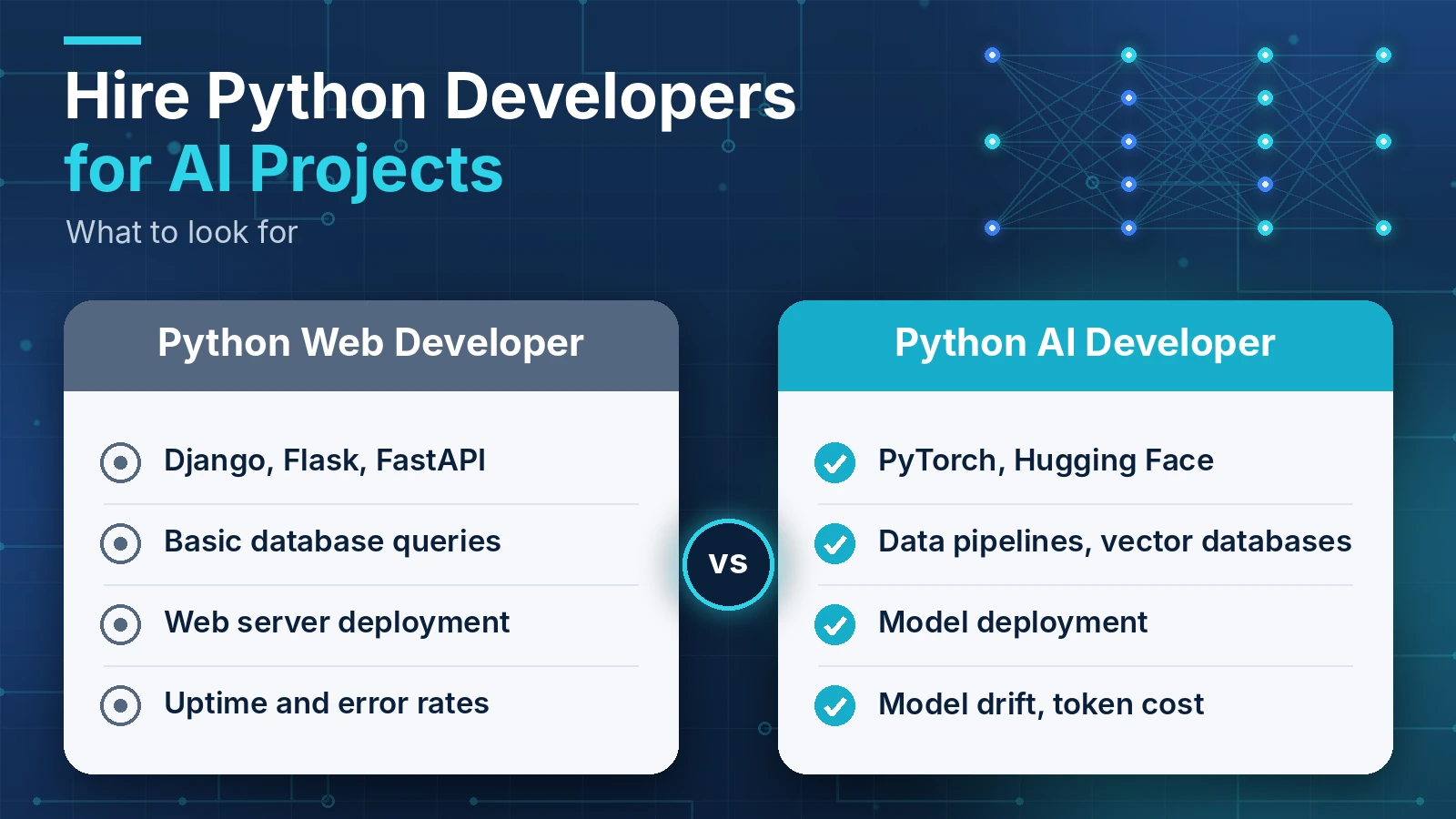
Python supports web development, automation, data science, and AI. However, the tools and skills needed for each area vary. A developer with years of Django experience may write clean code but still lack experience with ML models, vector databases, or model monitoring.
| Skill Area | Python Web Developer | Python AI Developer |
| Primary Frameworks | Django, Flask, FastAPI | PyTorch, TensorFlow, Hugging Face, LangChain |
| Data Work | Basic database queries | Data pipelines, feature engineering, vector databases |
| Deployment | Web server deployment | ML model deployment, inference optimization |
| Monitoring | Application uptime and error rates | Model drift, prediction quality, token cost |
| AI Knowledge | Limited or none | LLM integration, RAG pipelines, fine-tuning |
| Typical Hourly Rate | $20 to $40 per hour | $89 to $150 per hour — specialists $150 to $235 per hour |
Rates are indicative, not guaranteed. Compare current listings and provider quotes on Upwork and SecondTalent.
The language may be the same, but the work is not. Before you hire Python developers, define the AI tools, data needs, and production goals for your project.
What to Look for When You Hire Python Developers for AI Projects
When evaluating Python developers for AI work, the skills checklist looks very different from a standard Python developer assessment. At Quantal AI, we recommend checking practical experience across machine learning, LLM integration, data engineering, and production deployment. These skills help you identify developers who can build AI systems that perform reliably beyond the testing stage.
| Skill Area | What to Look For | Red Flag |
| ML Frameworks | PyTorch, TensorFlow, Scikit-learn or Keras — hands-on production use | Only knows one framework theoretically |
| LLM Integration | Experience integrating GPT-4o, Claude, Gemini or Llama into production systems | Has only used ChatGPT via the web interface |
| RAG Pipeline Development | Has designed and built RAG systems with vector databases like Pinecone or ChromaDB | Cannot explain chunking strategy or embedding model selection |
| Data Engineering | Data cleaning, preprocessing, feature engineering and pipeline management | No experience beyond Pandas in a notebook |
| MLOps and Deployment | Model deployment, monitoring, drift detection and retraining pipelines | Has never monitored a deployed model |
| Cloud Platforms | AWS SageMaker, Google Vertex AI or Azure ML — production deployments | Only local or notebook-based development |
| API Development | FastAPI or Flask for serving models and building scalable AI APIs | Cannot build a model serving endpoint |
| Vector Databases | Pinecone, Weaviate, ChromaDB or pgvector for RAG and semantic search | No vector database experience |
The skills above reflect what is required to build and maintain AI systems in 2026, not simply pass a general Python interview.
A python ai developer who has deployed models, monitored drift, and rebuilt pipelines after data changes is worth significantly more than someone with only experimentation experience. Keep these requirements in mind when you hire python developers or begin your python developer hire process.
For a detailed hiring process, read our guide on how to hire AI engineers and developers.
Interview Questions That Reveal AI-Specific Python Experience
Standard Python questions test coding knowledge. These questions help reveal whether candidates can deliver and maintain AI systems.
| Question | Strong Answer Includes | Weak Answer Looks Like |
| Tell me about a Python AI system you built that went into production. What broke after launch? | Specific post-launch failures — drift, latency, data quality, cost overruns | “Everything went smoothly” — no mention of real problems |
| How would you design a RAG pipeline in Python for 10,000 internal documents? | Chunking strategy, embedding model, vector database choice, re-ranking approach | “I would use LangChain” with no further detail |
| How do you serve a trained ML model via an API in production? | FastAPI or Flask endpoint, containerization with Docker, latency optimization, fallback handling | “I would use Flask” with no production detail |
| How do you handle model drift in a deployed Python AI system? | Monitoring framework, performance metrics, drift detection thresholds, retraining pipeline | “I would retrain periodically” with no specific approach |
| When would you fine-tune a model versus using RAG or few-shot prompting? | Cost, data volume, latency and use case specificity with clear reasoning | “Fine-tuning always gives better results” |
| How do you manage token costs in a high-volume LLM application? | Prompt caching, context window management, model selection strategy, cost monitoring | No awareness of token cost as a production concern |
Ask candidates to walk through their decisions and trade-offs. You can also review the AI developer hiring checklist for more screening questions.
Need experienced AI talent? See how Quantal AI matches engineers to projects.
Find Pre-Vetted Python Developers for Your AI Project
Looking for pre-vetted Python developers with verified AI project experience? Quantal AI helps businesses connect with skilled engineers who match their technical requirements, project scope, and delivery goals.
See how Quantal AI matches engineers to your project → Explore AI Engineering Services
The Paid Trial - The Most Effective Hiring Test
At Quantal AI, we recommend a 1–2-week paid trial using a real project task instead of relying only on whiteboard tests or algorithm challenges. This gives you a better understanding of how a Python AI developer performs in practical situations.
- Assign a real task: Ask the candidate to build a small RAG pipeline, model-serving endpoint, or data preprocessing pipeline.
- Review code quality: Evaluate documentation, clean code, testing, and communication, not just the final output.
- Test problem-solving: See how the candidate handles unclear requirements and changing priorities.
- Check out their questions: Strong developers clarify requirements before building rather than making assumptions.
A live build challenge helps you assess whether the candidate can deliver production-ready AI solutions.
Engagement Models When You Hire Python Developers for AI
At Quantal AI, we help businesses choose an engagement model based on their project scope, budget, and long-term requirements.
1. Freelance Python Developers
Freelancers work well for small, clearly defined AI tasks. In the US, mid-level developers typically charge $64–$85 per hour, while senior specialists charge $89–$150. Advanced LLM and RAG experts may charge $150–$235 per hour. You manage project delivery, quality checks, and communication.
2. Dedicated Python Developers
When you hire dedicated Python developers, you get an engineer working exclusively on your project. This model suits long-term AI development and ongoing system improvements. Through Quantal AI, businesses get vetted engineers matched to their technical stack within 24 hours.
3. Remote Python Developers
Businesses that hire remote python developers gain access to talent across different locations and time zones. US-based remote engineers offer convenient time zone collaboration, while Eastern European developers typically charge $40–$90 per hour, and LATAM developers $30–$60 per hour. This model offers flexibility without the overhead of traditional full-time hiring.
Ready to Hire Python Developers for Your AI Project?
At Quantal AI, a New York-based AI engineering studio, every Python developer in our network has verified production AI experience across LLM integration, RAG pipelines, MLOps, and cloud deployment. Choose dedicated, part-time, or project-based engagements, with engineers available within 24 hours. Our track record includes a 100% job success rate on Upwork.
Meet our Author

Nirav Shah
Co-Founder - Quantal AI