- September 1, 2026
- Admin Quantal AI
Finding a qualified AI engineer in 2026 takes an average of 4 to 6 months. By the time most companies hire, the project has already been delayed.
Companies now use AI for customer support, forecasting, fraud detection, product recommendations, document processing, and workflow automation, but successful AI projects need more than a good model. They need people who can turn an idea into a working, secure, and maintainable system.
That makes hiring an important part of any AI strategy. Companies must know which skills to look for, how to test technical ability, what different AI roles do, and how much hiring may cost.
If you plan to hire AI developer talent, start with the business problem. Then define the role around the work that needs to be done. This guide explains how to do that and how to build a stronger AI hiring process.
Key Takeaways
- Define the AI project before writing a job description
- Look for both AI knowledge and strong software engineering skills
- Use practical tests to assess how candidates solve real problems
- Compare in-house, remote, freelance, and agency hiring based on your needs
- Consider production experience, communication, and long-term support when you hire AI engineers
Define The Role Before You Start Hiring
A common mistake is starting with the job title. Start with the project instead.
AI engineers can work on very different systems. One may build a recommendation engine. Another may develop a document analysis system. A third may integrate a language model into an existing application.
Each role needs a different mix of skills.
Before you hire AI developer talent, answer these questions:
- What business problem will the person solve?
- What will they build?
- Which AI technology will the project use?
- What data will they work with?
- Which systems must the AI solution connect to?
- Will they handle deployment?
- Who will manage the project?
- What support will be needed after launch?
These answers help you create a focused job description.
They also prevent another common problem. Businesses sometimes expect one engineer to handle data engineering, model development, software development, cloud deployment, security, and product management.
That is rarely realistic. A small project may need one skilled engineer. A larger AI product may need several specialists. The hiring plan should match the project.
Understand What an AI Engineer Does
An AI engineer builds and integrates AI into software systems.
The role often combines software development, machine learning, data handling, and system integration. The exact responsibilities depend on the project.
An AI engineer may:
- Build AI-powered applications
- Integrate existing AI models
- Create APIs
- Prepare data pipelines
- Test AI outputs
- Deploy applications
- Monitor system performance
- Improve reliability
- Connect AI systems with existing software
The job is not only about building a model.
A model needs software around it. It may need databases, APIs, security controls, testing, monitoring, and user interfaces. IBM explains that AI developers apply AI technologies to software applications and solutions. Their work can include developing, testing, and integrating AI capabilities.
This is important when you hire AI engineers. A candidate may know how a model works but have little experience deploying it. Another may have strong software skills but limited experience with machine learning. Look at what the candidate has actually built.
Identify The Skills Your Project Needs
The right AI engineer skills in 2026 depend on the type of AI system being built. Still, some skills are useful across many projects.
Software Engineering
Look for experience with:
- Python or another suitable language
- APIs
- Databases
- Version control
- Testing
- Cloud platforms
- Deployment
- System monitoring
AI applications still need good software engineering. Clean code makes systems easier to maintain. Testing helps identify issues before users do. Good documentation helps other developers understand the system.
AI and Machine Learning
Candidates may also need knowledge of:
- Machine learning
- Deep learning
- Natural language processing
- Computer vision
- Model evaluation
- Model deployment
- Data preparation
Do not make every skill mandatory.
A candidate building an AI assistant does not need the same background as someone developing a computer vision system.
Data Skills
AI systems depend on data.
Candidates should understand how data is collected, cleaned, stored, and used. They should also understand how poor data can affect system performance.
Problem-Solving
Good engineers do not only follow instructions.
They ask questions, identify risks, compare options and then explain why one approach may work better than another. This matters when you hire machine learning engineer talent for complex projects.
Look Beyond Technical Skills
Technical abilities are important. But it is not enough. AI projects often involve product teams, business leaders, software developers, data teams, and security specialists. Engineers need to work with all of them.
They also need to explain technical ideas clearly. A business leader may not need to know how a model works at code level. They do need to understand what the system can do, what it cannot do, and what risks need attention.
The World Economic Forum's Future of Jobs Report 2025 lists AI and big data among the fastest-growing skills through 2030. It also highlights analytical thinking and collaboration as important skills for the changing workplace.
This is why we recommend assessing communication and problem-solving along with technical knowledge. The best candidate should be able to connect technical decisions with business goals.
AI Engineer Vs ML Engineer: Know the Difference
The AI engineer vs ML engineer distinction can be confusing.
The two roles overlap. The AI engineer vs ML engineer comparison becomes especially important when a project requires both application development and machine learning expertise.
- An ML engineer usually focuses more on machine learning models. This may include model development, training, optimization, deployment, and monitoring.
- An AI engineer may have a broader role. They can integrate AI models into applications and connect them with databases, APIs, workflows, and other software.
| Area | AI Engineer | ML Engineer |
| Main focus | AI-powered applications | Machine learning systems |
| Software development | Strong | Strong |
| Model development | Depends on project | Core responsibility |
| System integration | Major responsibility | Often required |
| Data pipelines | Common | Common |
| Model optimization | May be required | Frequent responsibility |
| Product integration | High | Varies |
| Production support | Common | Common |
The AI engineer vs ML engineer difference is not fixed across every company.
Job titles can vary. Responsibilities matter more than titles. If the project needs deep model development, an ML engineer may be the better fit. If it needs AI integration across a larger application, an AI engineer may be more suitable.
Understanding this difference can help you hire machine learning engineer talent with a clearer goal.
Build A Hiring Process That Tests Real Skills
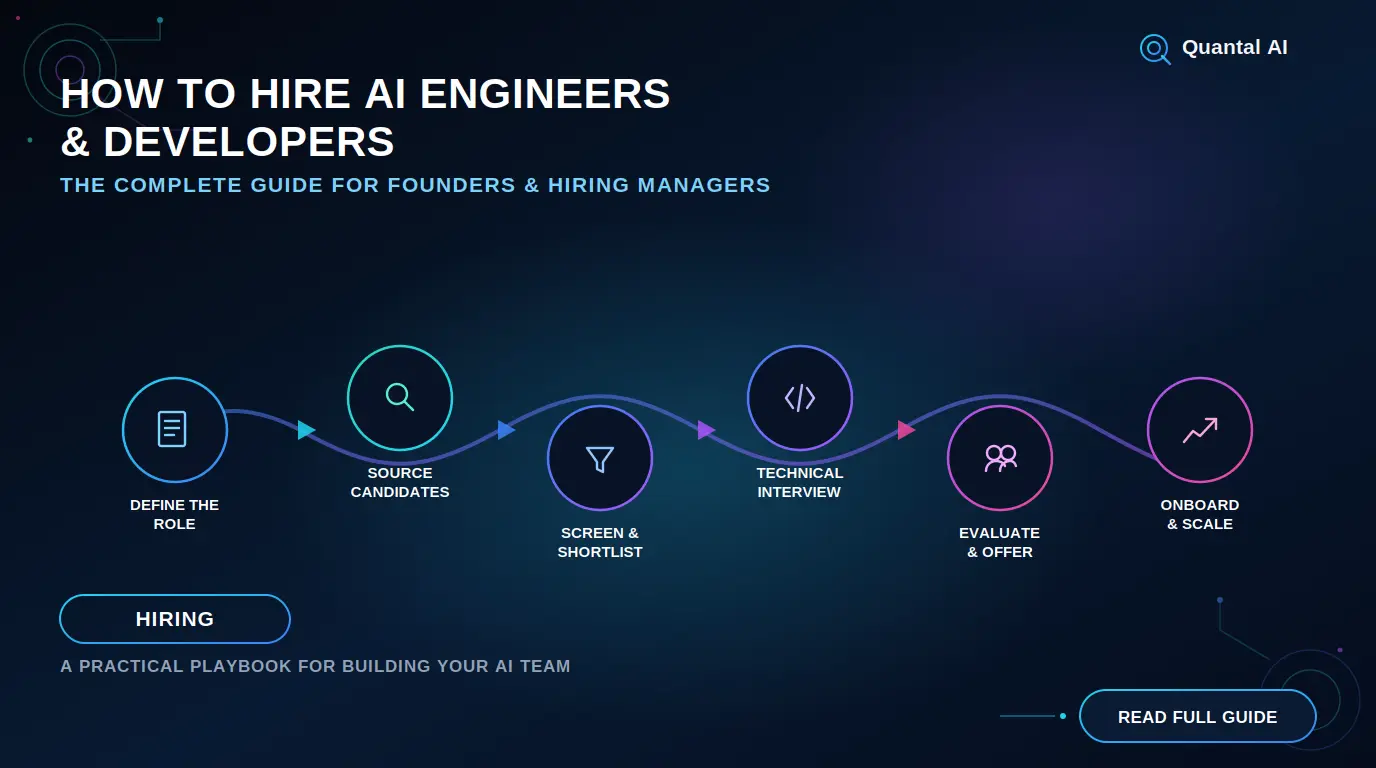
A strong hiring process should answer one question; can this person do the work? A five-stage process can help.
Stage 1: Resume Review
Look for relevant projects.
Do not count technologies without checking how they were used.
Stage 2: Technical Screening
Discuss software, AI, data, and previous projects.
Stage 3: Practical Assessment
Give the candidate a task based on the actual role.
Stage 4: Technical Interview
Ask them to explain their choices and trade-offs.
Stage 5: Team Discussion
Assess communication, ownership, and collaboration. This process is more useful than relying on a resume alone.
If you are learning how to hire AI engineers, start by testing the skills the person will use after joining.
How To Vet AI Engineers Before Hiring
Knowing how to vet AI engineers can save time. Start with their previous work. Ask candidates to explain:
- What problem they solved
- What they personally built
- What data they used
- Why they selected a particular approach
- How they tested the system
- How they handled failures
- How they deployed it
- What happened after deployment
- What they would change today
Pay attention to the details. A candidate who says they built an AI platform should be able to explain its architecture, data flow, testing process, and deployment method.
They should also be honest about what they did not build. This gives you a better picture of their actual experience. When you hire AI engineers, look for ownership rather than impressive technology lists. A strong candidate should be able to explain both successes and mistakes.
Ask Practical AI Engineer Interview Questions
Good AI engineer interview questions should test reasoning. Avoid building the entire interview around definitions. Give the candidate a business problem instead.
For example: A company wants to build an AI assistant that answers questions using its internal documents. How would you design it?
This is a classic RAG (Retrieval-Augmented Generation) use case, and a strong candidate should be able to walk you through the full architecture including document processing, vector storage, retrieval logic and response evaluation.
A strong candidate may discuss:
- Document processing
- Data storage
- Search and retrieval
- Model selection
- Access controls
- Testing
- Response evaluation
- Monitoring
You can also ask:
- How would you test an AI system before launch?
- How would you reduce incorrect responses?
- How would you protect sensitive data?
- What would you monitor after deployment?
- How would you control AI processing costs?
- When would you use an existing model?
- How would you prepare the system for higher traffic?
- What would you do if system performance dropped?
The goal is not to find one perfect answer. The goal is to understand how the candidate thinks.
Understand AI Engineer Salary in the USA
Salary depends on several factors.
Experience, location, industry, technical specialization, and company size can all affect compensation. When reviewing AI engineer salary usa 2026, do not look only at base pay.
The total cost may include:
- Base salary
- Bonuses
- Equity
- Health benefits
- Recruiting costs
- Equipment
- Training
- Payroll expenses
According to Built In, AI engineer salaries in the USA range from $120,000 to $250,000 depending on experience and specialization. It should not be used as a fixed number for every candidate. Location also matters. Major technology hubs may have higher salary expectations than smaller markets. Businesses should compare the full hiring cost with the expected value of the project.
Consider Remote AI Engineering Talent
Qualified AI engineers are not easy to find. The AI talent shortage means businesses often wait months before finding the right candidate, which is why many are exploring remote and external hiring options. Local hiring is not the only option.
When you hire AI engineers remotely, you can access a wider talent pool.
This can help when:
- Local talent is limited
- The project needs a rare skill
- Hiring must happen quickly
- The company already works remotely
- A specific time zone is required
But remote hiring needs structure.
Set clear expectations around:
- Working hours
- Time-zone overlap
- Meetings
- Documentation
- Code reviews
- Security
- Project ownership
- Communication
Understanding how to hire AI engineers remotely also means deciding which tasks need live meetings and which can happen asynchronously.
Clear documentation becomes especially important when teams work across different locations.
Remote hiring can expand your options, but it does not remove the need for strong management.
Compare In-House, Freelance, And Agency Hiring
There is no single hiring model that works for every company.
| Hiring Model | Best For | Main Benefit | Main Limitation |
| In-house | Long-term AI programs | Deep company knowledge | Higher long-term commitment |
| Freelance | Short projects | Flexible support | Limited team capacity |
| Remote employee | Wider talent search | Larger talent pool | Needs strong remote processes |
| Agency | Complex AI projects | Access to multiple skills | Partner selection takes care |
| Staff augmentation | Existing teams | Adds skills quickly | Internal team manages delivery |
An in-house engineer can be useful when AI is central to the company's long-term plans.
A freelancer may suit a short or well-defined project. An agency can help when a project needs several technical skills. Staff augmentation can help an existing team fill a specific skill gap. The best option depends on the project.
Know When to Hire an ML Specialist
Some AI projects need deeper machine learning skills.
You may need to hire machine learning engineer talent when the work involves:
- Custom model development
- Model optimization
- Fraud detection
- Recommendation systems
- Forecasting
- Computer vision
- Large-scale prediction
- Advanced model evaluation
Other projects need broader engineering skills.
For example, an AI customer support product may need someone who can connect models with an application and manage the surrounding systems.
A fraud detection project may need more focus on model performance and data. The role should follow the problem.
Avoid Common AI Hiring Mistakes
AI hiring can become costly when companies rush.
Here are some mistakes to avoid.
Hiring Based Only on Certifications
Certifications show learning.
They do not prove production experience.
Asking For Every AI Skill
A long list of requirements can reduce the number of suitable candidates.
Focus on what the project actually needs.
Ignoring Software Engineering
AI systems need clean code, testing, security, deployment, and maintenance.
Skipping Practical Assessments
Interviews show how people explain their work.
Practical tests show how they approach real tasks.
Focusing Only on Models
A model is only one part of an AI system.
Forgetting Post-Launch Work
AI systems need monitoring and updates after launch.
These checks can help you find engineers who can support the system beyond its first release.
Evaluate An AI Development Partner Carefully
Not every company needs to build a large internal AI team.
Some businesses may need external expertise for a specific project or a defined period.
When reviewing a development partner, look at:
- Relevant project experience
- Technical expertise
- Industry knowledge
- Security practices
- Development process
- Testing methods
- Communication
- Deployment support
- Maintenance
- Team scalability
Ask who will work on your project, how the partner handles testing, how sensitive data will be protected, and what support is available after launch.
Businesses that plan to hire AI developer talent through an external partner should also review previous projects and technical case studies.
Price should not be the only factor. A lower initial quote may become expensive if the project needs to major rework later.
Start With a Clear AI Hiring Plan
Before you contact candidates, document the project.
A simple plan should cover:
- Business problem
- Expected outcome
- AI use case
- Required technical skills
- Data requirements
- Security needs
- Project timeline
- Budget
- Team structure
- Post-launch support
Then decide how many people you need. A proof of concept may need one engineer. A production platform may need several specialists.
These could include AI engineers, ML engineers, data engineers, software developers, cloud specialists, and product managers. The team can grow as the project grows.
Build A Team That Can Support AI Long Term
Hiring should not stop at the first release. AI systems need ongoing work. Data can change. User behavior can change. Models can perform differently over time. New security needs can also emerge.
This means companies need people who understand the full AI life cycle.
- When evaluating AI developer talent, ask how the candidate approaches maintenance.
- When evaluating candidates, assess their ability to work across development, testing, deployment, and monitoring.
- When you hire machine learning engineer talent, consider their experience with model performance after deployment.
A strong AI team should be ready for both launch and long-term improvement.
Make Your AI Hiring Decision with Confidence
Hiring AI talent is a business decision as much as a technical one. The right process starts with a clear project. It then moves through skill definition, candidate screening, practical assessment, interviews, and hiring model selection.
Companies should not choose candidates based only on job titles or technology lists. They should look at what candidates have built, how they solve problems, and whether they can support systems in production.
The right hiring model also varies. Some businesses need permanent employees. Others may benefit from remote specialists, freelancers, staff augmentation, or an external development partner.
Quantal AI helps businesses build AI capabilities through experienced engineering teams and structured AI engineering services. They work with organizations that need practical AI expertise for products, automation, and enterprise applications. Their approach focuses on matching technical skills with business needs rather than applying one hiring model to every project.
Businesses that need help building an AI team can connect with Quantal AI to discuss their requirements and explore an AI development approach that fits their goals.