
- November 16, 2026
- Admin Quantal AI
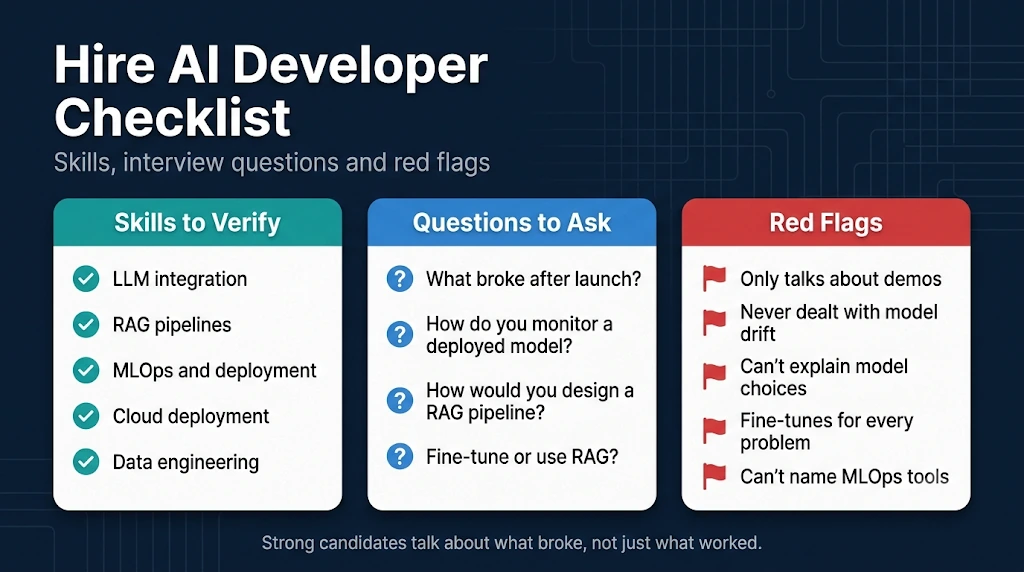
OVERVIEW
For a narrow AI task, check the developer’s LLM integration and data pipeline skills, then give them a practical build challenge. For a production system, look for experience with retrieval-augmented generation (RAG), deployment, and monitoring. One useful test when you hire AI developer talent is to ask what broke after launch and how they fixed it.
Introduction
Many hiring managers assess AI developers through coding tests and polished portfolios. These can show technical ability, but they may not prove that a candidate can run a reliable system in production. A demo that works once is not the same as software that works every day.
At Quantal AI, we recommend checking real delivery experience alongside technical knowledge. This checklist covers AI engineer skills, practical AI engineer interview questions, and warning signs that hiring teams should not ignore. It helps founders, CTOs, and engineering leads make a better hiring decision.
Key Takeaways
- Test production experience, not just coding ability.
- Strong AI engineer skills include LLM integration, RAG, data engineering, and deployment.
- Use practical AI engineer interview questions to test problem-solving.
- Watch for candidates who cannot explain failures or model choices.
- A structured ai engineer interview process with production-focused questions consistently outperforms unstructured technical interviews.
DEFINITION
What Is an AI Developer Skills Assessment?
A structured review of technical skills in machine learning, LLM integration, data engineering, and MLOps. It checks whether a candidate can build and maintain a real system.
What Are AI Engineer Interview Questions?
Questions that reveal how a candidate designs, deploys, and supports AI systems. Good questions test real experience rather than memorized definitions.
What Are AI Developer Red Flags?
Warning signs that a candidate may struggle to deliver reliable AI software. Examples include no production experience, weak reasoning, and no clear account of past failures.
Core AI Developer Skills to Look for Before You Interview
When you hire AI developer talent, do not rely on framework knowledge alone. The skills required for AI engineer roles depend on the project, but a strong candidate should explain technical choices in plain language. These AI developer skills help show whether someone can build a system that works beyond a demo.
| Skill Area | What to Look For | Why It Matters |
| Machine Learning Fundamentals | Supervised, unsupervised and reinforcement learning — can they explain when to use each | Without ML fundamentals a developer cannot make informed model decisions |
| LLM Integration | Hands-on experience with GPT-4o, Claude, Gemini or Llama in production systems | LLM integration is the core skill for most 2026 AI projects |
| RAG Pipeline Development | Experience designing retrieval-augmented generation (RAG) systems end to end | RAG is the most common architecture for enterprise AI applications |
| MLOps and Deployment | CI/CD for ML models, monitoring, drift detection and retraining pipelines | Without MLOps the model degrades silently after launch |
| Data Engineering | Data ingestion, preprocessing, feature engineering and pipeline management | AI systems are only as good as the data feeding them |
| Cloud Deployment | AWS SageMaker, Google Vertex AI or Azure ML — not just theoretical knowledge | Production AI runs on cloud infrastructure — not local machines |
| Framework Proficiency | PyTorch, TensorFlow, Hugging Face, LangChain or LangGraph | Framework fluency determines development speed and reliability |
The skills for AI engineer roles also include testing and debugging. The skills needed for AI engineer positions change with each project, so ask candidates to explain the trade-offs behind their choices. These are more useful signs than simply listing tools on a résumé.
For a broader hiring process, read How to Hire AI Engineers and Developers — The Complete Guide.
AI Engineer Interview Questions That Reveal Production Readiness
A useful AI engineer interview should test how a candidate handles real problems. Use these AI engineer interview questions to check their decisions, not just their definitions.
| Question | What a Strong Answer Includes | What a Weak Answer Looks Like |
| Tell me about an AI system you built that went into production. What broke after launch? | Specific failures include model drift, integration issues, data quality problems | “The deployment went smoothly” with no mention of problems |
| How would you design a RAG pipeline for 50,000 internal documents? | Chunking strategy, embedding model choice, vector database selection, re-ranking | “I would use LangChain” with no further detail |
| How do you prevent an LLM from hallucinating in a production application? | RAG grounding, output validation, prompt guardrails, human oversight | “Use a better model” or “adjust the temperature” |
| When would you fine-tune versus using RAG or few-shot prompting? | Cost, data volume, latency and use case specificity with clear reasoning | “Fine-tuning always gives better results” |
| How do you monitor an AI model after deployment? | Drift detection, performance metrics, alerting, retraining triggers, cost monitoring | “I check it periodically” or no mention of automated monitoring |
| Walk me through integrating an LLM into an existing CRM | API design, authentication, data privacy, latency management, fallback handling | A generic answer without mentioning real integration challenges |
| What is your preferred MLOps setup for 3 to 5 deployed ML models? | Specific tools — MLflow, Kubeflow, SageMaker Pipelines — with reasoning | Cannot name specific tools or explain trade-offs |
| How do you validate code or outputs generated by an AI coding assistant? | Specific review process, test coverage, edge case handling, false positive risks | “I trust it if it looks right” |
The best AI engineer interview questions reveal how candidates handle real limits and mistakes. Ask follow-up questions to check their role in the project. A strong AI engineer interview should also test how they review AI-generated code and handle unexpected results.
Need pre-vetted AI developers who have already passed this checklist? See how Quantal AI vets and matches engineers → Hire AI Engineers
Red Flags to Watch for When You Hire an AI Developer
When you hire AI developer talent, look beyond a strong portfolio. These warning signs may point to gaps in production experience.
| Red Flag | What It Signals |
| Only talks about demos and prototypes | Has not shipped AI to production or maintained a live system |
| Has never dealt with model drift | Has not operated ML at scale in a real production environment |
| Recommends fine-tuning for every problem | Not cost-aware or pragmatic — will over-engineer solutions |
| Cannot explain model selection reasoning | Following trends rather than making informed technical decisions |
| No data pipeline experience | Will create a bottleneck the moment real business data is involved |
| Cannot name specific MLOps tools | Has not deployed or operated ML models in a real engineering environment |
| Treats AI output as ground truth | Will create reliability and compliance risks in production |
| No examples of post-launch optimisation | Sees deployment as the finish line — not the starting point |
A candidate does not need to know every tool. However, they should explain why they chose a method and what they learned from failures. When you hire AI developer talent for a critical system, test this mindset before making an offer.
Your One-Page Hire AI Developer Checklist
Use this checklist to compare candidates during each interview. The same AI engineer skills criteria can help your team make fairer decisions.
| Category | Green Light | Red Flag |
| Production Experience | Built and maintained systems post-launch | Only built demos or prototypes |
| LLM Knowledge | Understands RAG, fine-tuning and prompt engineering trade-offs | Recommends fine-tuning for everything |
| MLOps | Uses specific tooling and monitors deployed models | No awareness of drift or monitoring |
| Data Engineering | Has built real data pipelines | No data pipeline experience |
| Model Selection | Evaluates models against requirements | Follows trends without reasoning |
| System Integration | Experience connecting AI to business systems | No API or integration experience |
| Production Mindset | Talks about failures, fixes and real constraints | Only talks about successful demos |
For Comparing in-house, freelance and agency hiring models read our In-House vs Freelance vs Agency: Which AI Hiring Model Is Right for You?
Need Help Finding a Vetted AI Developer?
At Quantal AI, we are a New York-based AI engineering studio, not a freelance marketplace or recruiting agency. We connect businesses with pre-vetted senior AI developers who have verified production experience. Our developers are available for dedicated, part-time, or project-based engagements within 24 hours. With a 100% job success rate on Upwork, we focus on helping businesses build reliable AI solutions.
Meet our Author

Nirav Shah
Co-Founder - Quantal AI