- November 26, 2026
- Admin Quantal AI
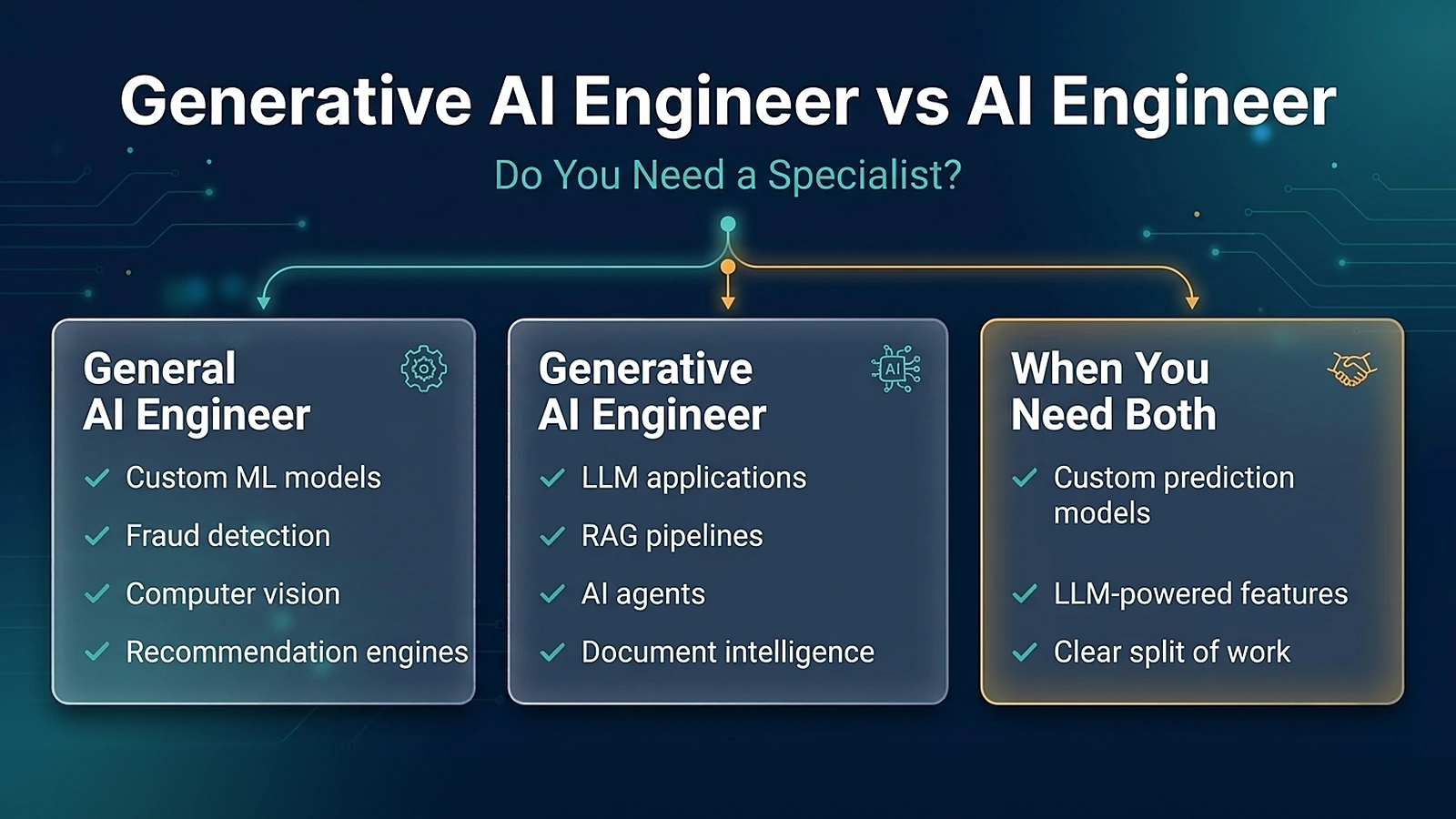
If your project needs custom machine learning models for tasks like fraud detection or prediction, hire a general AI engineer. If it needs large language models (LLMs), retrieval-augmented generation (RAG) or AI agents, hire a generative AI engineer. Some projects need both roles to build a reliable system.
Introduction
When businesses start evaluating AI talent, they often treat generative AI engineers and general AI engineers as interchangeable. The job titles sound similar, and resumes often use overlapping terms. However, their skills, tools, and project expertise differ. Hiring the wrong specialist can delay delivery, waste budgets, and create technical debt that grows over time. At Quantal AI, we help businesses understand these differences.
This guide gives hiring managers a clear framework for choosing between generative ai engineers and generative ai developers based on their actual project requirements.
Key Takeaways
- General AI engineers build custom machine learning models and work with structured data, computer vision, and predictive analytics.
- Generative AI engineers build applications using foundation models, LLMs, RAG pipelines, and AI agents.
- Choose a general AI engineer for custom prediction and classification tasks.
- Choose a generative AI specialist for chatbots, document intelligence, and LLM-based workflows.
- Some production systems need both roles to work well.
DEFINITION BOXES
What Is a General AI Engineer?
A general AI engineer builds machine learning (ML) systems that learn from data and make predictions. Their work includes classification, computer vision, recommendation engines, and predictive analytics. They may train custom models using tools such as PyTorch, TensorFlow, and Scikit-learn.
What Is a Generative AI Engineer?
If you are asking what is a generative AI engineer, the answer is an AI professional who builds applications powered by models that create new content. This content may include text, code, images, or audio. They work with foundation models from providers such as OpenAI, Anthropic, and Google. Their work can include RAG, prompt design, model fine-tuning, and AI agents.
What Are the Three Specializations Within Generative AI Engineering?
Generative AI work often involves three areas:
- Model builders adapt foundation models through methods such as LoRA and QLoRA.
- System and RAG integrators connect models to APIs, databases, and business tools.
- Prompt and evaluation engineers test outputs, set guardrails and check response quality.
The Core Difference Between the Two Roles
The clearest way to understand AI engineer vs generative AI engineer is to look at what each professional builds.
| Feature | AI Engineer | Generative AI Engineer |
| Primary Goal | Data analysis, classification and predictive modeling | Content generation, chatbots and copilot applications |
| Data Types | Structured, tabular, numerical and visual data | Unstructured text, multi-modal data and code |
| Model Approach | Trains custom models or fine-tunes specialized networks | Orchestrates pre-built foundation models via APIs |
| Tech Stack | PyTorch, TensorFlow, Scikit-learn, Keras | LangChain, OpenAI APIs, Anthropic, Hugging Face, vector databases |
| Typical Project Question | Which custom ML model should I build to classify or predict this data? | How do I integrate an LLM and design a RAG pipeline for a great user experience? |
| Key Deliverables | Trained models, data pipelines, MLOps infrastructure | LLM applications, RAG systems, AI agents, prompt frameworks |
Both roles may work on natural language processing, model for fine-tuning and deployment. However, their core skills differ. A general AI engineer may need time to learn about production RAG systems. A generative AI engineer may not have the depth needed to train a custom prediction model.
Which Engineer Does Your Project Need?
The right choice depends on what your project must do, not the job title or seniority level.
| Building a custom fraud detection model on transaction data | General AI Engineer | Requires custom model training on structured tabular data |
| Integrating ChatGPT or Claude into your product | Generative AI Engineer | Requires LLM API integration, prompt design and output validation |
| Building a document intelligence system for contracts | Generative AI Engineer | Requires RAG pipeline, entity extraction and LLM orchestration |
| Training a computer vision model for quality inspection | General AI Engineer | Requires custom CNN or vision transformer training on image data |
| Building an AI agent that automates a business workflow | Generative AI Engineer | Requires agent architecture, tool calling and LLM orchestration |
| Building a recommendation engine for an e-commerce platform | General AI Engineer | Requires collaborative filtering or ML ranking model on user behavior data |
| Fine-tuning a foundation model on your domain text | Generative AI Engineer | Requires LoRA or QLoRA fine-tuning pipeline and evaluation framework |
| Building an MLOps pipeline for deployed models | Either — depends on model type | General AI for custom models — Generative AI for LLM deployments |
If most tasks fit the generative AI column, hire generative AI developers with hands-on experience in RAG, LLM integration, and evaluation. If the project spans both columns, you may need both roles. Start by defining what the system needs to achieve.
You can also read Quantal AI’s guide on hiring machine learning developers to understand the skills needed for custom ML work.
Not sure which profile fits your project? Talk to Quantal AI through its AI consulting services to scope the right team.
When You Need Both - The Hybrid AI Team
Many production systems combine custom ML with generative AI. In such cases, hiring both types of engineers can help divide the work clearly.
Scenario 1 - AI-Powered Product with Custom and Generative Layers:
A SaaS platform may use a custom recommendation engine to rank content and a generative layer to summarize it. Each layer needs different skills.
Scenario 2 - Enterprise AI Platforms
A company may need predictive models for finance and risk, along with LLM-based tools for HR documents and customer support.
Scenario 3 – Existing ML System Adding Generative AI Features:
A business may already use a fraud model or churn predictor. It may then add a generative AI feature to explain results or prepare reports or customer communication.
A team with both skill sets can connect to these systems while keeping each part focused on its purpose.
Generative AI Engineer Skills vs. AI Engineer Skills - What to Verify
At Quantal AI, we recommend screening candidates based on practical skills rather than job titles alone. The following table highlights the key differences hiring managers should verify before making a decision.
Skills Comparison
| Skill Category | General AI Engineer | Generative AI Engineer |
| Primary Language | Python — PyTorch, TensorFlow, Scikit-learn | Python — LangChain, LangGraph, Hugging Face, OpenAI SDK |
| Model Knowledge | Custom model architecture, training loops, hyperparameter tuning | Foundation model selection, prompt engineering, LoRA fine-tuning |
| Data Skills | Feature engineering, tabular and image data pipelines | Text preprocessing, vector embeddings, chunking strategies |
| Retrieval and Search | Basic database querying | Vector databases — Pinecone, Weaviate, pgvector — semantic search |
| Deployment | MLflow, Kubeflow, SageMaker — model serving | LLM inference optimization, streaming responses, cost management |
| Evaluation | Accuracy, F1, AUC-ROC for classification and regression | RAGAS, LLM-as-judge, hallucination detection, latency benchmarks |
Use this comparison alongside our guide on how to hire AI engineers and developers to build a more effective screening process.
Ready to Find the Right AI Engineer for Your Project?
At Quantal AI, a New York-based AI engineering studio, we provide general AI and ML engineers as well as generative AI specialists, matched to your project requirements within 24 hours. With a 100% job success rate on Upwork, we help businesses build the right team for their needs. Whether you need LLM integration and RAG pipelines or custom model development, we scope the right team for your project.
Meet our Author

Nirav Shah
Co-Founder - Quantal AI