- November 23, 2026
- Admin Quantal AI
OVERVIEW
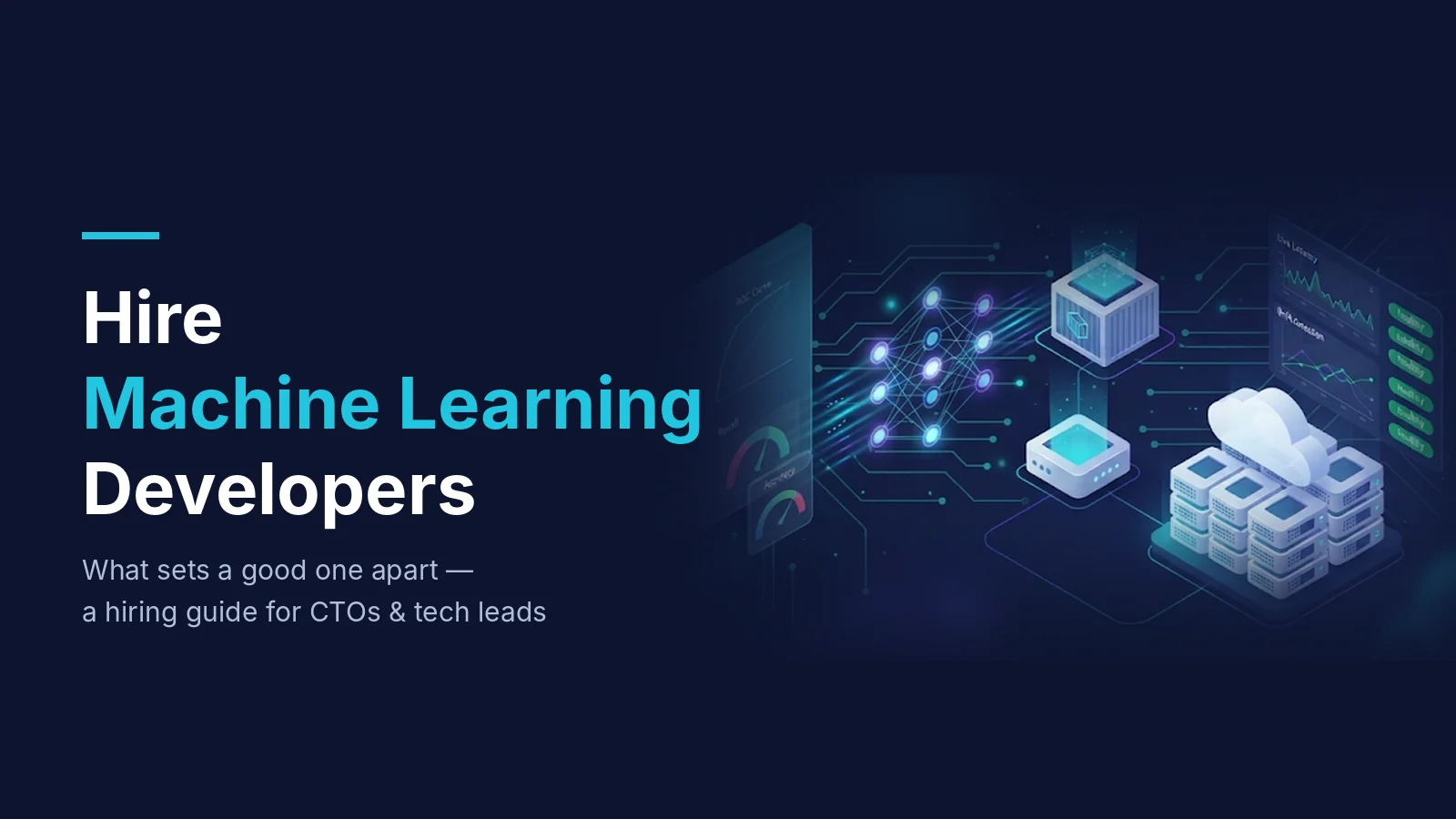
When you hire machine learning developers, look beyond the frameworks they know. A strong candidate can train a model, build its data pipeline, deploy it and monitor its performance after launch. Ask for a real example of a production system they have worked on and what went wrong after deployment.
Introduction
The machine learning talent pool may look large, but not every developer can build a system that works in the real world. Many can train models in a notebook. Far fewer can deploy them, manage live data and fix issues after launch. This gap makes hiring difficult for founders and technical leads.
At Quantal AI, we recommend checking out real project experience before you hire ML developers. This guide explains the skills, roles, and hiring costs that matter.
Key Takeaways
- The biggest hiring risk is choosing someone who can build a model but cannot deploy or maintain it.
- Strong machine learning developers understand data pipelines, model testing, and production deployment.
- ML developers, ML engineers, and data scientists often have different roles, so define what your project needs first.
- Upwork reports that machine learning engineers on its marketplace charge $50 to $200 per hour, and Second Talent publishes higher ranges for contractors in the United States.
- Ask candidates about a model they deployed and the problems they faced after launch.
DEFINITION BOXES
What Is a Machine Learning Developer?
A machine learning developer builds machine learning models and the systems that support them. Their work includes data pipeline development, model training, feature engineering, evaluation, and deployment. They focus on the practical engineering of ML systems rather than strategic architecture or advanced research.
What Is the Production vs Academic Gap in Machine Learning?
The production vs academic gap refers to the difference between developing ML models in experimental environments, such as Jupyter notebooks or Kaggle competitions, and deploying them in live systems. Production systems must handle real users, changing data, performance demands, and reliability requirements. Many developers have strong experimental skills but limited experience managing live ML applications.
What Is the Difference Between an ML Developer and an ML Engineer?
An ML developer focuses on building and training models, feature engineering, and data pipeline development. An ML engineer has a broader role that includes production deployment, MLOps, monitoring, drift detection, and infrastructure management. Production AI systems often need both capabilities, either within one experienced professional or across a small engineering team.
The Production vs Academic Gap - The Most Important Distinction in ML Hiring
At Quantal AI, we believe production experience is one of the most important factors when evaluating machine learning developers. Building a model in a notebook is different from managing one in a live business environment. A developer must know how to handle changing data, deployment issues, performance problems, and system failures. The following table highlights the key differences between academic and production of ML experience.
Production ML vs Academic ML Compared
| Capability | Academic or Notebook ML | Production ML |
| Model Building | Trains models in Jupyter notebooks | Trains models in reproducible pipelines |
| Data Handling | Uses clean pre-packaged datasets | Builds and maintains real data ingestion pipelines |
| Evaluation | Checks accuracy on test sets | Monitors performance on live business data after deployment |
| Deployment | Shares a notebook or a pickle file | Deploys via Docker, FastAPI or cloud ML platform |
| Monitoring | No post-training monitoring | Tracks drift, latency, cost and prediction quality |
| Failure Handling | No production failure experience | Has debugged real ML system failures |
| MLOps Awareness | Little or none | Uses MLflow, Kubeflow or SageMaker Pipelines |
A developer who performs well in academic ML can build impressive demos but may struggle when real user data arrives, and the model needs to perform reliably at scale.
When you hire ml developers for a production AI project, the right side of this table should be the baseline, not an advanced requirement.
ML Developer vs ML Engineer vs Data Scientist - Which Do You Actually Need?
At Quantal AI, we believe successful AI hiring starts with understanding the role your project needs. ML developers, ML engineers, and data scientists work with machine learning, but their responsibilities differ. Choosing the wrong specialist can lead to higher costs, delays, and gaps in project delivery. Before you hire machine learning developers, identify whether your project needs model development, production support, or data analysis. The table below explains the key differences.
ML Role Comparison
These are common definitions, not fixed industry rules, so confirm what each candidate has actually done.
| Role | Primary Focus | Best For | Not Suited For |
| ML Developer | Model building, data pipelines, feature engineering, training and evaluation | Projects that need custom ML models built from data | Running production infrastructure or deep statistical research |
| ML Engineer | Production deployment, MLOps, monitoring, drift detection, scalability | Projects with deployed models that need to stay reliable after launch | Pure model research or early experimentation |
| Data Scientist | Data exploration, statistical analysis, business insight, experimental modeling | Projects that need to find patterns in data and validate business hypotheses | Production engineering or maintaining live ML systems |
| NLP Specialist | Text processing, language models, named entity recognition, classification | Projects involving documents, customer communications or language data | Computer vision or tabular data prediction tasks |
| Computer Vision Specialist | Image and video processing, object detection, classification | Projects involving visual data — medical imaging, quality inspection, video | Text or tabular data tasks |
Most early-stage AI projects need an ML developer who can build and train a model using your data. Scaling projects often need an ML engineer who can keep that model reliable as data and traffic grow.
Hiring a data scientist when you need an ML developer, or vice versa, is a common and expensive mistake in AI team building. If you are unsure which role fits your requirements, read our guide on how to hire AI engineers and developers before making a hiring decision. When you hire ml developers, matching their skills to your project stage helps you build the right team from the start.
Core Skills to Verify When You Hire Machine Learning Developers
The right skills depend on the model and product. Still, most production roles need a mix of coding, data, and deployment skills.
| Skill Area | What to Look For | Red Flag |
| Python Proficiency | Production-grade Python, not just notebook scripting | Only writes Python in Jupyter, no software engineering habits |
| ML Frameworks | PyTorch, TensorFlow, Keras or Scikit-learn, hands-on production use | Only knows one framework from a tutorial |
| Data Pipeline Development | Building real ingestion, preprocessing, and feature engineering pipelines | Only works with pre-cleaned datasets |
| Model Evaluation | Beyond accuracy and precision, recall, F1, AUC-ROC appropriate to the use case | Optimizes for accuracy only no business metric alignment |
| MLOps and Deployment | Docker, FastAPI or Flask for model serving, CI/CD for ML, cloud platforms | Has never deployed a model outside a notebook environment |
| Cloud Platforms | AWS SageMaker, Google Vertex AI or Azure ML - production deployments | No cloud ML platform experience |
| Version Control | Git for code, DVC or MLflow for experiment and model tracking | No model versioning or experiment tracking experience |
| Monitoring | Drift detection, performance monitoring, and retraining triggers | No awareness of model degradation as a production concern |
Model drift occurs when changes in real-world data reduce a model's performance. Tools such as MLflow help teams track experiments and model versions.
MLOps, cloud deployment, and monitoring are strong signs of production experience. When you hire machine learning developers, ask them to explain how they have used these skills on a live project.
Looking for engineers who can take models beyond the testing stage? See how Quantal AI matches ML talent to project needs.
What to Ask When You Interview an ML Developer
At Quantal AI, we recommend asking practical questions that reveal whether a candidate has handled real production challenges. These three questions can help you assess their experience beyond model-building skills.
Question 1 - Tell me about an ML model you deployed to production. What broke after launch?
Strong candidates describe specific failures, such as data drift, feature distribution shifts, latency issues, or retraining pipeline failures. Vague answers may indicate limited production experience.
Question 2 - How do you handle model drift in a live ML system?
Look for answers covering monitoring frameworks, performance thresholds, alerts, and automated retraining triggers. Periodic retraining without a clear detection approach is not enough.
Question 3 - Walk me through how you would build a data pipeline for a new ML project from scratch.
Strong candidates explain data ingestion, validation, cleaning, feature engineering, and versioning, along with the tools they would use.
Machine Learning Developer Rates
Rates depend on seniority, location and engagement model. Upwork reports that machine learning engineers on its marketplace charge $50 to $200 per hour, rising with experience. Second Talent, a staffing firm, publishes higher ranges for contractors in the United States. For salaried hires, Indeed’s 2026 average for a U.S. machine learning engineer is $189,380 per year, according to Nexus IT Group’s salary guide. Averages vary widely by source and location.
| Source | Level | Hourly rate |
| Upwork (marketplace) | Beginner | $50 to $80 |
| Upwork (marketplace) | Intermediate | $80 to $120 |
| Upwork (marketplace) | Advanced | $120 to $200+ |
| Second Talent (U.S. freelance or contract) | Junior, 1 to 3 years | $95 to $142 |
| Second Talent (U.S. freelance or contract) | Mid-level, 3 to 6 years | $119 to $185 |
| Second Talent (U.S. freelance or contract) | Senior, 7 to 10 years | $155 to $235 |
We recommend looking past the hourly rate. A rate alone does not show whether a developer can deploy and maintain a model in production, so compare deployment, monitoring, and MLOps experience as well. Our pricing depends on the engagement model and the scope of the work.
Engagement Models When You Hire ML Developers
Choosing the right engagement model depends on your project scope, timeline, and technical needs. At Quantal AI, we offer flexible ways to access machine learning expertise.
Freelance ML Developers
Best for focused tasks such as building a specific model, creating a proof of concept, or developing a data pipeline. Marketplace and contract rates vary widely, as the rates table above shows. You manage the work and quality checks directly.
Hire Dedicated Machine Learning Developers
When you hire dedicated machine learning developers through a specialist partner, you get a full-time engineer matched to your technology stack. This works well for ongoing development and long-term ownership. It also helps businesses hire remote machine learning developers without limiting their talent search by location.
Machine Learning Development Services - Agency or Studio
Quantal AI’s machine learning development services cover data pipelines, model training, deployment, monitoring, and MLOps consulting. As an ML development company focused on production AI, we provide a complete engineering team for defined projects.
Ready to Hire Machine Learning Developers for Your Project?
At Quantal AI, we are a New York-based AI engineering studio with ML developers experienced in model training, data pipelines, cloud deployment, and MLOps. We offer dedicated, part-time, and project-based engagements, with engineers available within 24 hours and a 100% job success rate on Upwork. Whether you need a new model, a data pipeline, or production deployment, we match you with the right engineer for your requirements.
Meet our Author

Nirav Shah
Co-Founder - Quantal AI