- August 19, 2026
- Admin Quantal AI
AI is now used in many business systems. Companies use it for customer support, document processing, forecasting, recommendations, search, and workflow automation.
But who builds these systems? An AI engineer helps turn AI models and business needs into working software. Their work can cover data, model integration, application development, testing, deployment, and ongoing improvements.
So, what does an AI engineer do in a real business setting? The answer depends on the project. An engineer building an AI assistant may have different tasks from one developing a computer vision system.
This guide explains the role in simple terms. It covers key responsibilities, technical skills, related engineering roles, common tools, and what businesses should consider when hiring AI talent.
Key Takeaways
- AI engineers build and integrate AI into real software systems.
- Their work can cover data, models, applications, testing, deployment, and monitoring.
- Strong programming and problem-solving skills are important alongside AI knowledge.
- AI engineering overlaps software and machine learning, but each role has a different focus.
- Businesses should assess practical experience, communication, and production skills when hiring AI talent.
What Does an AI Engineer Do in Business?
An AI engineer develops software that uses artificial intelligence to solve a business problem.
The work often starts with a simple question.
What should the AI system help the business achieve?
It could help a support team answer customer questions. It could process large volumes of documents. It could identify unusual transactions. It could help employees find information faster.
The engineer then works on the technical solution.
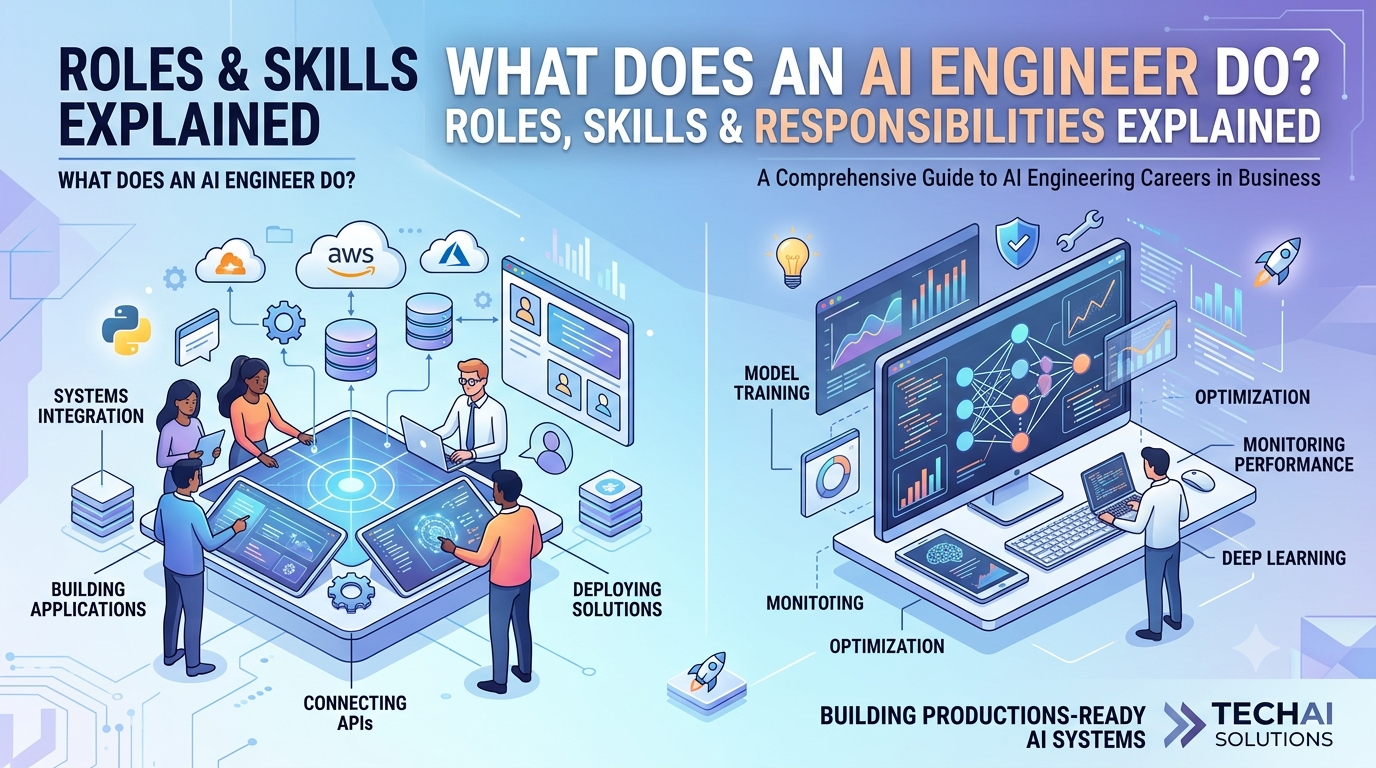
Typical tasks include:
- Understanding business and technical requirements
- Selecting suitable AI models
- Preparing and managing data
- Building AI-powered features
- Connecting models with applications
- Creating APIs
- Testing AI outputs
- Deploying systems
- Monitoring performance
- Improving the system after launch
This explains why AI engineer responsibilities can differ from one project to another.
IBM describes AI developers as professionals who apply AI technologies to software applications covering development, testing, and integration of AI capabilities. The role is not only about training models. An AI engineer must often make sure the AI works properly within a larger software environment.
For example, a model may perform well during testing. The production system may still need authentication, access controls, error handling, monitoring, and reliable application logic. The engineer helps bring these parts together.
How AI Engineers Turn Business Problems into Working Systems
AI development usually begins with a business need.
A company may want to reduce manual document review. Another may want to improve customer service. A retailer may want better recommendations.
The AI engineer helps decide whether AI is suitable for the problem.
The process may look like this:
Business Need → Data Review → AI Approach → Development → Testing → Deployment → Monitoring
Each stage needs technical judgment.
The engineer may review the available data and identify gaps. They may compare different models. They may decide whether an existing model is enough or whether a custom solution is needed.
They also need to consider cost, speed, accuracy, security, and maintenance.
This makes AI engineering both technical and practical.
A good engineer does not use AI simply because it is available. They choose an approach that fits the actual business problem.
What Are the Main AI Engineer Roles and Responsibilities?
The AI engineer roles and responsibilities can change as a project moves from planning to production.
Designing The AI Solution
The engineer helps define the technical approach.
This can include:
- Selecting suitable models
- Designing system architecture
- Planning data flows
- Defining integrations
- Identifying technical risks
The goal is to create a practical design before development begins.
Developing AI Applications
The engineer then builds the system.
This may involve:
- Writing application code
- Connecting AI models
- Building APIs
- Creating data pipelines
- Integrating third-party services
- Adding business rules
The AI model needs to work with the rest of the application.
Testing AI Systems
AI systems need careful testing.
An engineer may test:
- Accuracy
- Response quality
- Speed
- Reliability
- Failure cases
- Security
- Processing costs
Testing should use realistic business scenarios.
Deploying And Monitoring Systems
Building the system is only one part of the job.
The engineer may deploy it to a cloud or enterprise environment. After launch, they monitor performance and investigate issues.
They may check system errors, response quality, processing time, and usage.
Improving The System
AI systems often need updates.
Engineers may improve data pipelines, adjust models, improve prompts, fix bugs, or change system logic.
This makes ongoing maintenance an important part of AI engineer responsibilities.
Which AI Engineer Skills Matter Most?
The required AI engineer skills depend on the project.
Still, strong candidates often need knowledge across several areas.
Programming And Software Development
Python is widely used for AI and machine learning.
Depending on the project, engineers may also work with Java, JavaScript, TypeScript, C++, or other languages.
The important point is not the number of programming languages.
It is the ability to build reliable software.
Machine Learning Knowledge
An AI engineer should understand relevant machine learning concepts.
These may include:
- Model training
- Model evaluation
- Classification
- Regression
- Neural networks
- Data preparation
- Model deployment
The depth required depends on the role.
Data Handling
AI systems depend on data.
Engineers should understand how data is collected, cleaned, stored, processed, and passed to models.
Poor data can affect system performance even when the model itself is strong.
APIs And System Integration
Many AI applications use APIs to connect models with other software.
Engineers should know how systems communicate and how to handle errors when an external service fails.
Cloud And Deployment
Production AI systems often run on cloud infrastructure.
Experience with AWS, Microsoft Azure, or Google Cloud can be useful. Engineers may also work with containers, CI/CD pipelines, databases, and monitoring tools.
Security
AI systems can process sensitive business or customer information.
Engineers need to understand authentication, authorization, data protection, and secure system design.
Security should be part of the design from the start.
What Does Research Say About AI Engineering Skills?
The demand for AI skills is growing across industries.
The World Economic Forum's Future of Jobs Report 2025 identifies AI and big data as the fastest-growing skill area through 2030. The report also highlights analytical thinking as a key core skill for workers.
This matters because AI engineering is not only about technical tools. Engineers also need to analyze problems, make decisions, and work with other teams. When companies assess AI engineer skills, they should therefore look at both technical knowledge and practical problem-solving.
The same principle applies when businesses hire AI expert talent for complex projects.
AI Engineer Vs Software Engineer: What Is the Difference?
The AI engineer vs software engineer comparison is useful when defining a hiring plan.
Both roles require strong programming and software development skills, but their areas of focus are different. Understanding the AI engineer vs software engineer distinction helps businesses decide which type of expertise their project requires.
The main difference is their area of focus.
A software engineer may build applications, backend services, databases, or infrastructure. An AI engineer works more directly with AI models, machine learning systems, data, and AI-powered features.
| Area | AI Engineer | Software Engineer |
| Main focus | AI-powered systems | Software applications |
| Programming | Core skill | Core skill |
| Machine learning | Often required | Usually not central |
| Data handling | Common | Depends on role |
| AI model integration | Strong focus | May be required |
| System design | Important | Important |
| Testing | Required | Required |
| Cloud deployment | Often required | Often required |
| Model evaluation | Common | Usually not central |
The AI engineer vs software engineer distinction is not always strict. A software engineer may have strong AI experience. An AI engineer may also have deep software development skills.
The project should determine which skills matter most.
AI Engineer Vs ML Engineer: How Are They Different?
The AI engineer vs ML engineer distinction can be harder to define because the roles overlap.
An ML engineer often focuses more deeply on machine learning models. This can include model development, training, optimization, deployment, and monitoring.
An AI engineer may have a broader application focus.
They can integrate AI models into applications and connect those models with databases, APIs, workflows, and other systems.
| Area | AI Engineer | ML Engineer |
| AI application development | Strong focus | May vary |
| Machine learning models | Common | Core focus |
| Model training | Project dependent | Common |
| Model optimization | May be required | Common |
| Software integration | Strong focus | Often required |
| Data pipelines | Common | Common |
| Production deployment | Common | Common |
| Product development | Strong focus | Varies |
Titles can vary between companies. That is why hiring teams should review actual responsibilities instead of relying only on job titles. Understanding the AI engineer vs ML engineer difference can help companies define roles more clearly.
Not Sure, Whether Your Project Needs an AI Engineer or ML Engineer?
Talk to our team and we will help you identify the right expertise for your specific use case, so you hire the right person for the right problem.
What Does an AI Engineer Work on Each Day?
There is no single daily routine. The work changes with the project stage.
A typical day may include:
- Reviewing technical requirements
- Writing and reviewing code
- Testing model outputs
- Checking data pipelines
- Reviewing system performance
- Joining product meetings
- Fixing production issues
- Improving AI responses
- Reviewing code from other engineers
As agentic AI becomes more common in business, engineers are also increasingly building and maintaining autonomous AI systems that can complete multi-step tasks without human intervention. An engineer may spend one day improving a model and the next fixing an API or deployment issue.
This variety is common because AI systems sit across several technical layers. The role is also collaborative.
Engineers may work with product managers, data scientists, software developers, designers, security teams, and business stakeholders.
Which Tools Do AI Engineers Commonly Use?
The tools depend on the project.
An AI engineer may work with:
- Python
- PyTorch
- TensorFlow
- Scikit-learn
- SQL
- REST APIs
- Docker
- Kubernetes
- Git
- Cloud platforms
- Databases
- Vector databases
- Large language model APIs
Large language models, or LLMs, are AI models trained on large amounts of text. They can process and generate language.
For LLM-based applications, engineers may also work with:
- Retrieval systems
- Embedding models
- Prompt management
- Evaluation tools
- Agent frameworks
- Model monitoring
A strong engineer does not need to know every tool. They need to know how to choose the right tools for the project.
How AI Engineers Move Systems into Production
Building a model in a development environment is different from running it in production.
Production systems must handle real users and real data.
An AI engineer may need to consider several factors.
Performance
How quickly does the system respond?
Reliability
What happens when a service fails?
Cost
How much does each request cost?
Security
Who can access the system and its data?
Quality
Does the AI produce useful results?
Monitoring
How will the team know when performance drops?
These questions are central to practical AI engineering.
The goal is not only to make AI work.
The goal is to make it work reliably within the business environment.
What Are AI Engineer Responsibilities After Launch?
The work does not end when an AI application goes live.
Post-launch AI engineer responsibilities can include:
- Monitoring system performance
- Fixing technical issues
- Updating models
- Improving data quality
- Reviewing user feedback
- Reducing processing costs
- Improving response quality
- Managing infrastructure
- Updating integrations
AI systems can need regular updates.
A model may perform well at launch but become less useful as data or user behavior changes.
The engineer helps keep the system useful and stable.
This is one reason production experience matters when businesses hire AI expert talent.
How Should Businesses Assess AI Engineer Skills?
Resumes can show experience.
Practical assessments can show capability.
When evaluating AI engineer skills, ask candidates to explain projects they have actually worked on.
Useful questions include:
- What problem did the project solve?
- What was your role?
- What data did you use?
- Why did you choose that model?
- How did you test the system?
- How did you handle failures?
- How did you deploy it?
- What did you monitor after launch?
- What would you change today?
You can also give candidates a small project based on the role. For example, ask them to design an AI document processing system.The goal is not to demand production code from a short test. Instead, assess their reasoning.
- Can they identify the data requirements?
- Can they explain their model choice?
- Can they identify risks?
- Can they design a testing approach?
These answers can tell you more than a list of certifications.
When Should a Business Hire an AI Expert?
Businesses may need to hire AI expert support when they have a clear AI project but lack the required specialist knowledge.
This may happen when an internal software team needs support with:
- AI strategy
- Technical architecture
- Model selection
- AI application development
- LLM integration
- AI agents
- Retrieval systems
- AI testing
- Production deployment
The right hiring model depends on the project.
A company may need one specialist for a short engagement. Another business may need a complete engineering team.
The key is to match the technical expertise with the actual project gap.
What Should Businesses Look for When Hiring AI Engineers?
A strong hiring process should assess more than technical terms on a resume. Look for evidence of real project experience.
A candidate should be able to explain:
- The business problem.
- The technical approach.
- Their personal contribution.
- The challenges they faced.
- How they tested the solution.
- How they deployed it.
- What happened after deployment.
Communication also matters.AI engineers often need to explain technical choices to people who are not engineers. The best candidates can explain complex ideas in simple language.They also know when to challenge an assumption.That can prevent businesses from investing in the wrong AI approach.
For a complete walkthrough of the hiring process, read our guide on how to hire AI engineers and developers.
How AI Engineering Is Evolving In 2026
AI engineering is becoming broader. According to McKinsey's State of AI report, 88% of organizations now regularly use AI in at least one business function driving demand for engineers who can work across traditional ML, LLMs, AI agents and automated workflows simultaneously.
Engineers now work with traditional machine learning, LLMs, AI agents, multimodal systems, retrieval systems, and automated workflows. This changes the skills required for many roles.
For example, an AI agent may need a language model, external tools, databases, business rules, access controls, and monitoring. The engineer must think about the complete system.
This makes software engineering more important, not less.As AI becomes part of business operations, companies need engineers who can build systems that are secure, reliable, scalable, and maintainable.
See How Quantal AI Approaches AI Engineering
At Quantal AI, we build production-ready AI systems for real business needs spanning AI engineering, AI agents, LLM applications, automation, integrations and enterprise AI.
Our process starts with understanding your business requirement. We then move through architecture, development, deployment, and ongoing optimization, keeping every project focused on practical outcomes rather than technology alone.
If your business needs specialist AI engineering support without building every capability, internally explore our AI engineering services or talk to our team.
Build AI Teams Around the Right Business Need
Understanding what does an AI engineer do helps businesses make better hiring and project decisions.
The role can cover AI development, software integration, data, testing, deployment, monitoring, and maintenance.
The exact mix depends on the project. Companies should define the business problem before defining the job title. They should assess practical experience and look for engineers who can explain their technical decisions clearly.
The right engineer is not simply someone who knows many AI tools. It is someone who can use the right technology to solve the right problem.
At Quantal AI we help businesses build and scale AI systems through experienced engineering teams. We support businesses at every stage from initial architecture and development through deployment, monitoring, and long-term optimization.
Our approach focuses on understanding your business requirements before selecting the technical path. Connect with us to discuss your requirements and explore an AI engineering approach that fits your goals.