
- July 22, 2026
- Admin Quantal AI
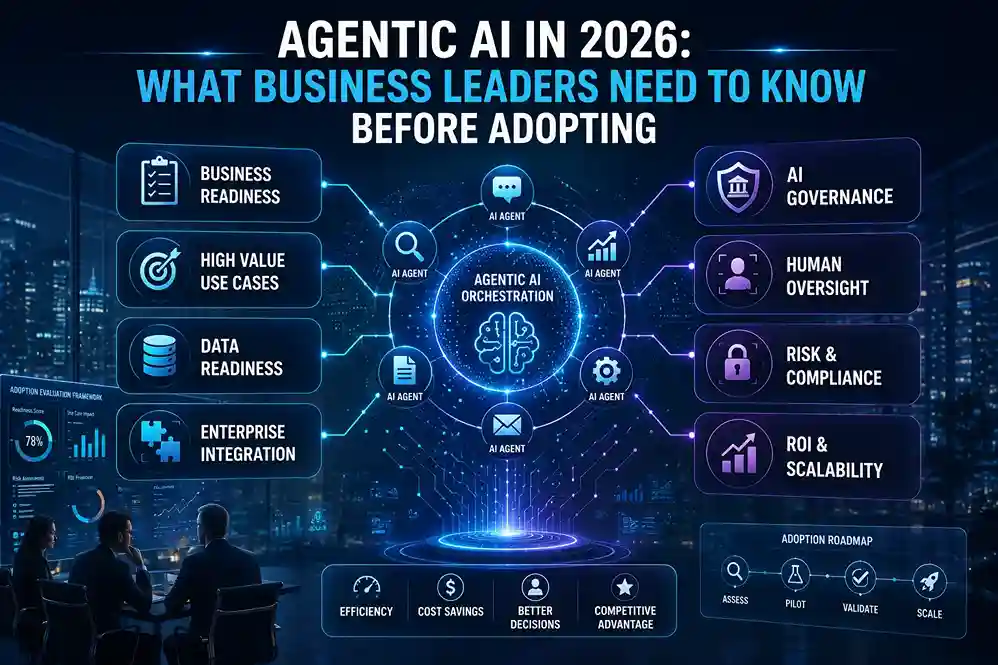
Artificial intelligence has moved beyond answering questions and generating content. Businesses are now exploring systems that can plan tasks, make decisions within defined limits, and complete multi-step workflows with minimal human input. This new approach is known as agentic AI.
As more organizations evaluate agentic AI adoption, business leaders need to understand both the opportunities and the challenges before making investments. While the technology promises greater automation and efficiency, success depends on selecting the right use cases, managing risks, and building strong governance.
This guide explains what is agentic AI, how it differs from traditional AI, where businesses are using it today, and what leaders should consider before adopting it in 2026.
Key Takeaways
- Agentic AI can plan, execute, and adapt tasks instead of only responding to prompts.
- Successful agentic AI adoption starts with business goals, not technology.
- Security, governance, and human oversight remain essential for every AI initiative.
- Businesses should begin with targeted agentic AI use cases before expanding across departments.
- A structured implementation plan helps organizations gain long-term value while reducing operational risks.
What Is Agentic AI?
Many business leaders are asking what is agentic AI, and why it has become one of the biggest technology discussions in 2026.
Agentic AI refers to artificial intelligence systems that can independently perform a series of actions to achieve a specific goal. Unlike traditional AI tools that wait for human instructions at every step, agentic systems can analyze information, create plans, execute tasks, evaluate results, and adjust their approach when needed.
According to IBM, agentic AI systems can reason, plan, and execute tasks with a degree of autonomy while working toward defined objectives.
For example, a customer service chatbot typically answers questions based on predefined information. An AI agent, however, can receive a customer request, search internal systems, verify account details, generate a response, schedule follow-up actions, and notify the support team if human assistance is required.
Most modern agentic systems use Large Language Models (LLMs). An LLM is an AI model trained in large amounts of text to understand and generate human language. Agentic AI builds these models by adding planning, reasoning, memory, and access to business applications.
Instead of acting as a simple assistant, an AI agent works more like a digital team member that can complete structured tasks while operating within defined business rules.
As organizations continue exploring agentic AI 2026 trends, understanding this difference is becoming increasingly important for business leaders.
Why Agentic AI Is Becoming a Business Priority
Business leaders are under constant pressure to improve productivity, reduce operational costs, and deliver faster customer experiences. Traditional automation has helped streamline repetitive work, but many business processes still require employees to switch between systems, gather information, and make routine decisions.
This is where agentic AI for business processes offers a different approach.
Instead of automating only one task, AI agents can manage connected activities across multiple systems. They gather information, evaluate available options, complete approved actions, and report results back to employees.
Several factors are driving agentic AI adoption across industries.
Growing Business Complexity
Organizations now manage large volumes of customer interactions, documents, compliance requirements, and operational data every day. AI agents can help process this information more efficiently while reducing manual effort.
Rising Customer Expectations
Customers expect quick responses and personalized experiences. AI agents can support service teams by handling routine requests while allowing employees to focus on more complex situations.
Workforce Productivity
Many businesses are looking for ways to improve employee productivity without increasing headcounts. AI agents help reduce repetitive administrative work and allow employees to spend more time on strategic activities.
Better Decision Support
AI agents can collect information from multiple business systems, summarize insights, and recommend the next steps. Human teams still make final decisions, but they receive faster and more organized information.
For many organizations, agentic AI for business leaders is no longer just a technology discussion. It has become part of broader business planning, digital transformation, and operational efficiency strategies.
Agentic AI vs traditional AI
Many organizations already use AI in some form. However, understanding agentic AI vs traditional AI helps business leaders decide where each approach fits.
| Feature | Traditional AI | Agentic AI |
| Primary role | Responds to specific prompts | Plans and completes multi-step tasks |
| Decision making | Limited to predefined instructions | Can evaluate options within approved boundaries |
| Workflow execution | Usually performs one task at a time | Coordinates multiple connected actions |
| Human involvement | Required at most stages | Required for supervision and approvals |
| Adaptability | Limited | Can adjust workflows based on changing inputs |
| Business value | Improves individual tasks | Improves end-to-end business processes |
Traditional AI remains valuable for activities like document summarization, content generation, and data analysis.
Agentic AI extends those capabilities by connecting multiple business systems and executing complete workflows while keeping humans in control.
Understanding agentic AI vs traditional AI allows organizations to choose the right solution instead of replacing every existing AI system.
Common Agentic AI Use Cases Across Industries
The value of AI agents becomes clearer when viewed through real business applications. Many organizations are starting with focused projects before expanding across departments.
Some of the most common agentic AI use cases include:
Customer Support
AI agents can:
- Resolve routine customer requests
- Check account information
- Process refunds within approved limits
- Escalate complex issues
- Schedule follow-ups automatically
This reduces response times while improving customer satisfaction.
Sales Operations
Sales teams often spend significant time updating CRM systems, qualifying leads, and preparing proposals.
AI agents can:
- Research prospects
- Update customer records
- Schedule meetings
- Generate proposal drafts
- Recommend follow-up actions
This allows sales professionals to focus on customer relationships rather than administrative work.
Finance And Accounting
Finance departments use AI agents to support:
- Invoice processing
- Expense validation
- Financial reconciliation
- Compliance checks
- Report preparation
These activities reduce manual processing while improving consistency.
Human Resources
HR teams can automate routine activities such as:
- Candidate screening
- Interview scheduling
- Employee onboarding
- Policy guidance
- Internal support requests
Employees receive faster assistance while HR professionals focus on strategic workforce planning.
Healthcare Administration
Healthcare organizations are exploring agentic AI use cases for appointment scheduling, patient communication, insurance verification, documentation support, and administrative coordination while maintaining strict regulatory compliance.
These examples show how agentic AI for business processes can improve efficiency without replacing human expertise.
What Business Benefits Can Organizations Expect?
Organizations evaluating agentic AI adoption often ask whether the investment delivers measurable value. The answer depends on selecting the right business problems and implementing AI with proper governance.
Some of the most significant agentic ai benefits for business include:
- Faster completion of repetitive workflows
- Better employee productivity
- Improved customer response times
- Reduced operational costs
- More consistent decision support
- Better visibility into business processes
- Improved scalability during business growth
One important advantage is continuity. AI agents can work across multiple business systems without needing constant supervision, helping teams maintain consistent service levels even during busy periods.
Another benefit is improved collaboration. Instead of replacing employees, AI agents handle repetitive work while human teams focus on judgment, creativity, relationship management, and strategic decision-making.
As organizations continue evaluating agentic AI 2026, many leaders view AI agents as productivity tools rather than workforce replacements.
How To Implement Agentic AI Successfully
Many organizations are excited about AI, but successful agentic AI adoption requires careful planning. Deploying AI agents without a clear business objective often leads to poor results, higher costs, and limited user acceptance.
When considering how to implement agentic AI, we advise business leaders to treat it as a business transformation project rather than just another technology upgrade.
Start With Business Problems
We recommend avoiding AI adoption simply because competitors are doing it.
Instead, identify processes that:
- Require repetitive decision-making
- Involve multiple manual steps
- Consume significant employee time
- Have clear business rules
- Produce measurable outcomes
For example, invoice approvals, customer onboarding, employee support requests, and contract reviews are often better starting points than highly complex strategic tasks.
Starting with a focused project allows organizations to demonstrate value before expanding AI across the business.
Assess Data Readiness
AI agents depend on reliable information to make appropriate decisions.
Before implementation, organizations should review:
- Data quality
- Data accessibility
- Security controls
- Existing business applications
- Integration capabilities
Incomplete or outdated data can reduce the effectiveness of AI agents, regardless of how advanced the underlying technology may be.
Keep Humans in the Loop
One of the biggest misconceptions about AI agents is that they eliminate the need for human involvement.
At Quantal AI, we believe successful agentic AI for business leaders focuses on collaboration between people and AI.
Employees should continue to:
- Review high-risk decisions
- Approve financial transactions
- Handle customer escalations
- Monitor AI performance
- Update business rules
Human oversight helps maintain accountability while improving trust across the organization.
Build Governance from Day One
In our experience, governance added after deployment creates significant operational risk.
Business leaders should define:
- Who approves AI actions
- Which tasks require human review
- Data access permissions
- Compliance requirements
- Audit and reporting processes
Clear governance allows AI agents to operate safely while supporting business objectives.
Measure Business Outcomes
Every AI initiative should have measurable success metrics.
Examples include:
- Reduced processing time
- Lower operational costs
- Faster customer response times
- Higher employee productivity
- Improved service quality
- Fewer manual errors
Tracking these outcomes helps organizations evaluate returns on investment and identify opportunities for improvement.
Understanding how to implement agentic AI is not only about deploying new technology. It is about creating a sustainable operating model that balances automation with human expertise.
Not sure where to start with agentic AI? We help businesses identify the right use cases, build governance frameworks, and deploy AI agents that fit their existing workflows.
Agentic AI risks Every Business Leader Should Understand
While AI agents offer significant opportunities, business leaders must also understand the potential agentic AI risks before expanding adoption.
Ignoring these challenges can affect operational performance, regulatory compliance, and customer trust.
Some of the most common agentic AI risks include:
Data Privacy and Security
AI agents often access multiple business systems to complete tasks. Without proper control, organizations may expose sensitive customer or company information. Strong authentication, encryption, and access management remain essential.
Incorrect Decision Making
AI agents can only perform as well as the data and instructions they receive. If business rules are incomplete or information is inaccurate, AI may recommend inappropriate actions. Regular monitoring and validation reduce this risk.
Compliance Challenges
Industries such as healthcare, finance, insurance, and legal services operate under strict regulations. Organizations must ensure AI systems comply with industry standards, record-keeping requirements, and privacy laws.
Over-Automation
Not every process should be automated. Some business activities require human judgment, emotional understanding, or strategic thinking. Attempting to automate these tasks may reduce service quality rather than improve it.
Employee Adoption
Technology alone does not guarantee success. Employees need training to understand:
- When AI should be used
- When human intervention is necessary
- How to supervise AI outputs
- How to report issues
Organizations that involve employees early often achieve higher adoption rates.
Managing agentic AI risks requires a balanced approach that combines technology, governance, and workforce readiness.
Questions Business Leaders Should Ask Before Investing
Before approving an AI initiative, leadership teams should evaluate whether the organization is truly prepared.
Consider these questions:
- What business problems are we trying to solve?
- Which workflows consume the most employee time?
- Do we have reliable and secure data?
- Which decisions should always require human approval?
- How will we measure business value?
- Can our existing systems be integrated with AI agents?
- Do employees have the skills needed to work alongside AI?
- Are we prepared to manage ongoing governance and monitoring?
These discussions help organizations avoid unnecessary investments while improving the chances of successful agentic AI adoption.
What Will Agentic AI Look Like In 2026?
The conversation around agentic AI 2026 is shifting from experimentation to practical business adoption. Instead of isolated AI tools, organizations are building connected AI ecosystems where multiple agents work together across departments.
Several trends are expected to shape the next phase of adoption.
Multi-Agent Collaboration
Businesses are beginning to deploy specialized AI agents for finance, customer service, operations, procurement, and human resources.
These agents can share information while supporting different business functions.
Better Enterprise Integration
Future AI agents will connect more easily with CRM platforms, ERP systems, document management software, communication tools, and business intelligence platforms.
This will reduce manual work across departments.
Stronger Governance
As adoption grows, organizations will place greater emphasis on:
- Responsible AI policies
- Security frameworks
- Audit trails
- Compliance reporting
- Human oversight
Governance will become a competitive advantage rather than simply a regulatory requirement.
As organizations deploy more autonomous AI systems, strong governance becomes essential to define the limits of AI capabilities, reduce risks, and ensure accountability. The World Economic Forum Identify governance as a critical factor for the safe adoption of AI agents.
More Industry-Specific Solutions
Instead of generic AI platforms, businesses will increasingly adopt AI agents designed for healthcare, financial services, manufacturing, retail, logistics, and professional services.
These specialized systems better understand industry workflows and compliance requirements.
For many organizations, agentic AI 2026 represents the beginning of a more structured and responsible approach to enterprise automation rather than widespread autonomous decision-making.
Why A Strategic Approach Delivers Better Results
Businesses often focus on technology first and business outcomes later.
We recommend identifying measurable operational challenges first, and then prioritize high-impact workflows, and introduce AI gradually.
From our work with enterprise clients, organizations that succeed with agentic AI adoption typically:
- Start with limited business use cases.
- Build governance alongside deployment.
- Keep humans involved in important decisions.
- Continuously monitor AI performance.
- Expand only after demonstrating measurable business value.
For organizations evaluating an AI agent development company in USA, it is equally important to assess technical expertise, industry experience, security practices, and long-term support capabilities instead of focusing only on implementation speed.
By following a phased approach, businesses can capture the long-term agentic ai benefits for business while reducing operational and compliance risks.
Preparing Your Business for the Next Phase Of AI
The future of AI is not about replacing people. It is about helping teams work smarter, making faster decisions, and improving business outcomes. We have seen that organizations approaching agentic AI with clear objectives, strong governance, and realistic expectations are more likely to see long-term success than those chasing technology trends.
Business leaders should begin by understanding what is agentic AI, identifying high-value opportunities, and selecting practical agentic AI use cases that solve real operational challenges. A phased rollout allows teams to learn, measure results, and improve before expanding AI across the organization. At the same time, leaders must continue addressing agentic AI risks through strong security, human oversight, and responsible governance.
As agentic AI 2026 continues to evolve, organizations that combine technology with thoughtful planning will be better positioned to improve efficiency, customer experience, and business resilience.
Businesses looking to move from exploration to implementation can benefit from working with experienced partners who understand enterprise AI development. Quantal AI specializes in custom AI solutions for enterprises, helping organizations design and deploy AI agents that align with business goals, operational workflows, and compliance requirements. Their team focuses on practical AI solutions that deliver measurable business value while supporting responsible and scalable adoption.