
- September 30, 2026
- Admin Quantal AI
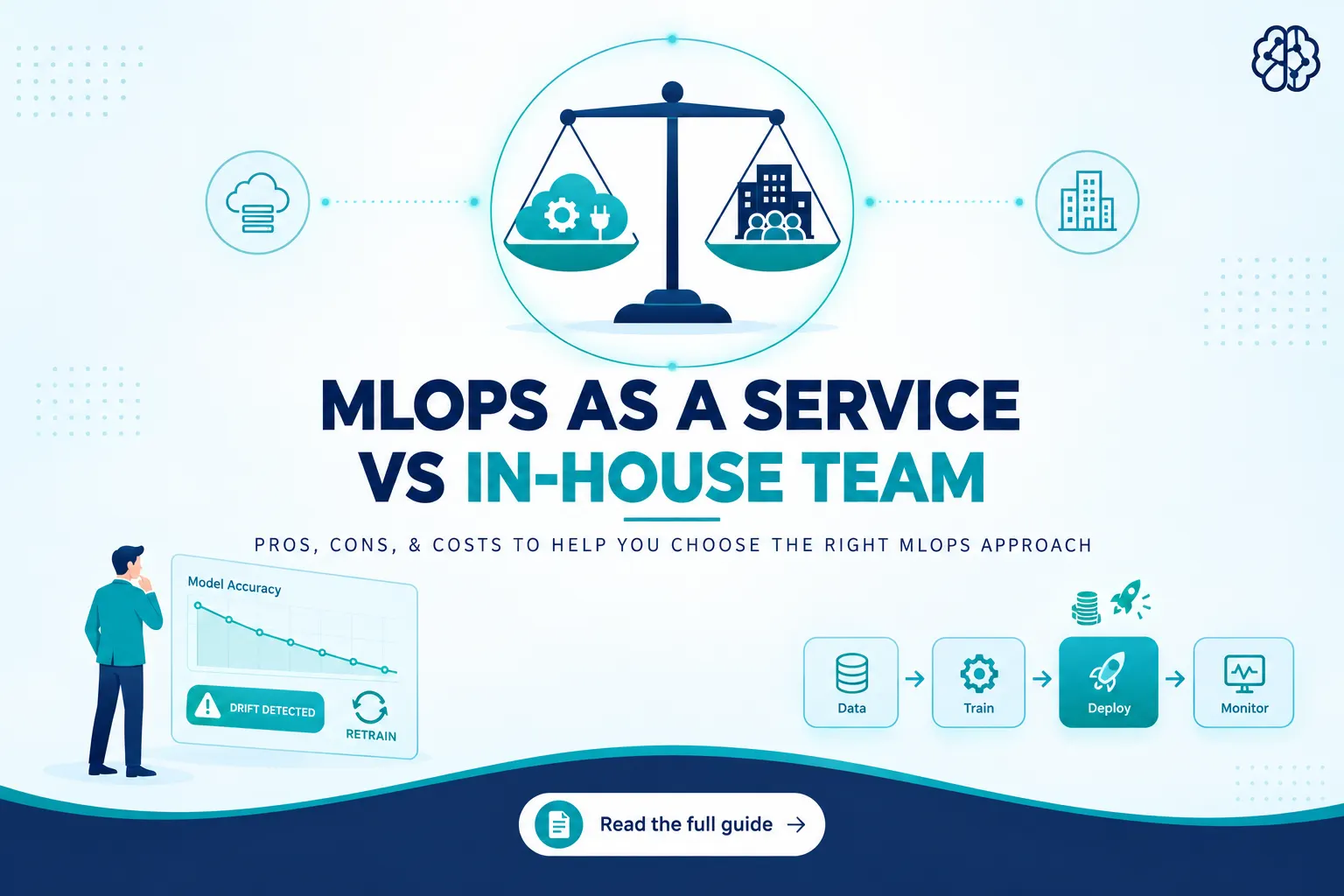
Machine learning projects extend beyond developing models. Businesses must deploy, monitor, manage data pipelines, retrain models, and maintain systems. This is the role of MLOps.
As ML adoption grows, businesses often face a practical decision: should they build an in-house MLOps team or work with an external MLOps consulting services? The build vs buy MLOps decision depends on factors such as technical expertise, project scale, available resources and the level of control a business needs.
Both approaches have advantages and limitations. Knowing this helps businesses choose an MLOps model that fits current needs without extra cost or complexity.
Key Takeaways
- MLOps as a service offers businesses quicker access to specialized ML expertise.
- An in-house MLOps team offers more control but costs more to hire and set up.
- The right approach depends on ML maturity, workload, budget and long-term goals
- Outsourcing helps businesses scale ML projects without full internal teams.
- A hybrid approach can combine external expertise with internal ownership
What is MLOps and why is it different from DevOps?
MLOps merges machine learning, data engineering, and software practices to help organizations deploy ML models into reliable production environments.
While MLOps shares practices with DevOps, machine learning adds challenges, read our detailed breakdown of mlops vs devops to understand the key differences. A software app may behave consistently if unchanged, but an ML model can lose accuracy due to data or real-world changes.
MLOps therefore needs processes for:
- Model deployment and version control
- Data and model validation
- Model performance monitoring
- Detecting model or data drift
- Automated retraining
- ML pipeline management
- Governance and security
This is why MLOps services usually involve more than standard application deployment and infrastructure management.
What is MLOps as a service?
MLOps as a service lets businesses work with external teams for ML operations, including infrastructure, deployment, monitoring, automation, model management, and optimization.
This approach can be particularly useful for companies with data scientists and ML developers but without dedicated MLOps expertise.
Businesses can use MLOps consulting to evaluate their architecture, find operational gaps, and build a scalable MLOps framework before managing more in-house.
MLOps services vs in-house MLOps team: what is the difference?
| Factor | MLOps as a Service | In-House MLOps Team |
| Initial investment | Generally lower | Generally higher |
| Hiring requirement | Limited | Significant |
| Access to expertise | External specialists | Internal specialists |
| Control | Shared | Direct |
| Scalability | Easier to adjust | Depends on team capacity |
| Implementation time | Often faster | May take longer |
| Long-term ownership | Shared or external | Internal |
The better option depends on what the business needs today and how its ML operations are expected to develop over time.
What are the pros and cons of an in-house MLOps team?
An internal team offers close collaboration among MLOps engineers, data scientists, developers, and stakeholders, which is valuable for machine learning as a core product component or when systems need specialized internal knowledge.
Advantages
- Direct control over infrastructure, processes and deployment
- Close collaboration with internal engineering and data teams
- Better knowledge of proprietary systems and business requirements
- Greater control over security and governance decisions
- Long-term technical knowledge remains within the organization
Challenges
The main drawback is the investment required to build and maintain the team. An organization may need MLOps engineers, cloud specialists, platform engineers, and supporting technical resources. Businesses looking to hire machine learning engineers with MLOps expertise should also factor in the time and cost of finding qualified candidates in a competitive hiring market.
Overall, MLOps team cost also includes salaries, cloud infrastructure, monitoring tools, training, security, and ongoing maintenance. Hiring experienced professionals can further increase initial investment.
What are the pros and cons of MLOps as a service?
External MLOps providers can give businesses access to specialized skills without requiring them to hire a complete internal team immediately.
Advantages
- Faster access to specialized expertise
- Lower initial hiring requirements
- Flexible support as ML workloads change
- Access to established MLOps processes and tools
- Useful for teams moving ML models into production for the first time
Challenges
Outsourcing also requires careful planning. Businesses need clear agreements around data access, security, infrastructure ownership, documentation, and responsibilities.
There may also be less direct control over certain operational processes. For long-term ML programmes, businesses should compare recurring service costs with the investment required to build internal capabilities.
How much does it cost to build an in-house MLOps team?
No single cost applies to every business. The investment depends on team size, the complexity of ML workloads, and the infrastructure used.
Major cost areas include:
- MLOps and cloud engineering salaries
- Cloud computing and storage
- CI/CD and orchestration tools
- Model monitoring and observability
- Security and governance
- Training and professional development
- Ongoing infrastructure maintenance
For smaller teams, hiring multiple specialists may be difficult to justify if ML workloads are still limited. Larger organizations with continuous production of ML requirements may find the investment more practical over the long term.
Should you outsource MLOps or build in-houses?
The decision should be based on the organization's ML maturity, not simply on cost. An in-house approach may make more sense when:
- ML is central to the business model
- The organization already has strong engineering talent
- Long-term internal ownership is important
- ML workloads are large and predictable
- The business has the resources to maintain dedicated infrastructure
Businesses may outsource MLOps when they have a smaller technical team, need specialized expertise or want to move projects into production without spending months building an internal function.
When should a business use MLOps consulting services?
MLOps consulting can be useful at several stages of an ML programme. A business may seek external support when it is:
- Moving ML models from experimentation into production
- Designing its first MLOps architecture
- Experiencing deployment or monitoring problems
- Scaling existing ML workloads
- Improving model lifecycle management
- Preparing to build a larger internal MLOps capability
The goal is not always to outsource the entire function. Consulting can also help businesses establish the right processes and infrastructure before taking greater ownership.
Is MLOps as a service worth it for small and mid-size businesses?
For small and mid-size businesses, MLOps as a service can be practical when the cost and effort of building a full internal team outweigh the need for permanent MLOps capacity.
It can provide access to specialized expertise while allowing internal teams to focus on product development, data science, and business priorities. However, the provider should still be evaluated for technical capability, security practices, scalability, and understanding of the business's ML environment.
Choosing the right MLOps approach
The choice between an external MLOps model and an in-house MLOps team ultimately depends on the business's ML maturity, technical resources, workload, and long-term plans. MLOps as a service can provide flexibility and specialized expertise, while an internal team can offer greater control and deeper organizational ownership.
Quantal AI’s ai ml services helps businesses build, deploy and manage machine learning solutions with MLOps practices suited to their technical and operational requirements. Its expertise can support organizations that need to establish reliable ML workflows, scale existing systems, or strengthen their internal capabilities.
For businesses evaluating their next step, choosing the right MLOps model can make ML operations more manageable, scalable, and sustainable.