- August 21, 2026
- Admin Quantal AI
AI and machine learning are now part of many business systems. But building an AI model is only one part of the work. Teams also need to deploy it, monitor it, update it, and keep it reliable.
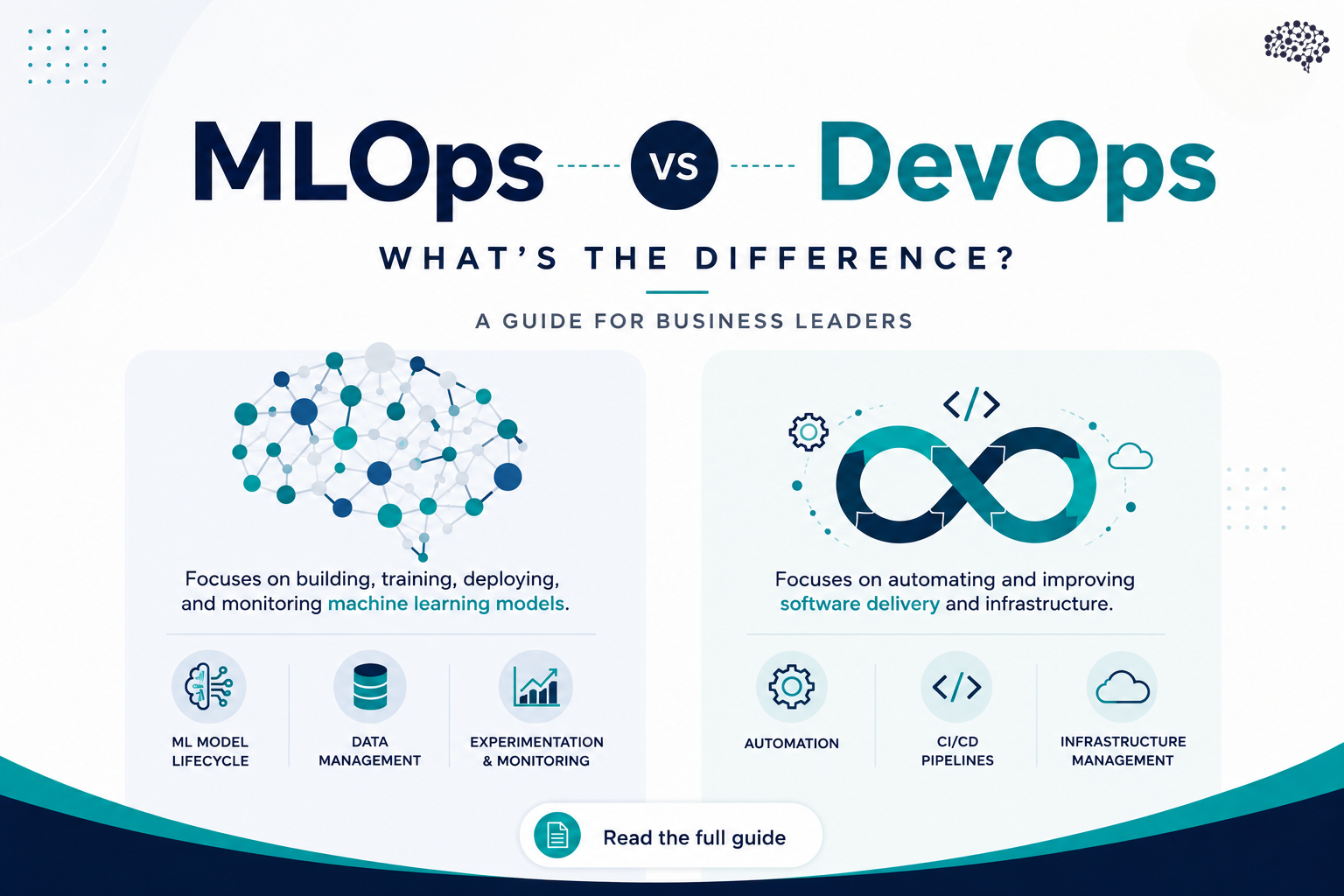
This is where MLOps and DevOps enter the picture. MLOps and Devops can sound like two competing approaches. In practice, they solve related but different problems. DevOps focuses on software delivery and operations. MLOps extends these practices to machine learning systems, where data and model behavior add new challenges.
For business leaders, knowing the difference can help with better planning. It can also prevent teams from adding tools or processes they do not need.
This guide explains both approaches in simple terms. It also covers where they overlap, how they differ, and when each one makes sense.
Key Takeaways
- MLOps and Devops are related practices, but they manage different types of systems.
- DevOps focuses mainly on software development, deployment, infrastructure, and operations.
- MLOps adds data, model training, model monitoring, and retraining to the software lifecycle.
- Businesses often need both when an AI product includes traditional software and machine learning.
- The right choice depends on the type, scale, and operational needs of the project.
What Is DevOps and Why Does It Matter?
What is Devops?
DevOps is a way of bringing software development and IT operations closer together.
It combines processes, tools, and team practices that help businesses build and release software faster and more reliably.
Common DevOps practices include:
- Continuous integration
- Continuous delivery
- Infrastructure as Code
- Automated testing
- Application monitoring
- Release automation
- Infrastructure management
Continuous integration means developers regularly merge code into a shared repository. Automated tests can then check the changes.
Continuous delivery helps prepare tested code for release.
AWS describes DevOps as a combination of cultural practices and tools that help organizations deliver applications and services at higher speed and quality.
The main goal is straightforward.
Build software, test it, release it, and operate it in a repeatable way.
This makes DevOps useful for websites, mobile applications, APIs, SaaS platforms, and other software products.
What Is MLOps And How Does It Work?
What is MLOps?
MLOps stands for Machine Learning Operations.
It applies software delivery and operations practices to machine learning systems. But it also deals with issues that are specific to machine learning.
A machine learning model learns patterns from data. Its performance can change when the data changes.
That creates an additional operational challenge.
An MLOps workflow can include:
- Data preparation
- Model training
- Model testing
- Model versioning
- Model deployment
- Performance monitoring
- Data monitoring
- Model retraining
Google Cloud defines MLOps as practices for managing the machine learning lifecycle from development through deployment and monitoring.
A useful way to understand it is this:
- DevOps manages software delivery.
- MLOps manages software plus the machine learning lifecycle around the model.
That difference becomes important once a business puts a machine learning system into production.
Why Machine Learning Needs More Than Standard DevOps
A normal software application follows rules written by developers.
A machine learning system also depends on data.
That creates new questions.
- What happens if the data changes?
- What if the model becomes less accurate?
- What if a new training dataset produces a worse model?
- What if customer behavior changes over time?
A standard application monitoring system may tell a team that the service is running.
It may not tell them that the model's predictions are becoming less useful.
This is one reason MLOps and Devops should not be treated as identical concepts. MLOps adds processes for model and data management.
Google's MLOps guidance highlights a key difference: machine learning pipelines need to test and validate not only code, but also data and models.
MLOps Vs DevOps: The Main Differences
The MLOps vs Devops comparison becomes easier when the two approaches are placed side by side.
| Area | MLOps | DevOps |
| Main focus | Machine learning systems | Software systems |
| Code management | Yes | Yes |
| Data management | Core requirement | Usually secondary |
| Model versioning | Required | Not normally required |
| Model monitoring | Core activity | Not usually applicable |
| Model retraining | Often required | Not applicable |
| CI/CD | Used | Used |
| Continuous training | May be required | Not applicable |
| Infrastructure | Important | Important |
| Application monitoring | Yes | Yes |
| Model performance | Core concern | Not applicable |
| Data drift | Important | Not applicable |
The MLOps vs Devops difference is therefore not about one replacing the other. It is about the system being managed. DevOps is well suited to conventional software. MLOps is designed for systems where machine learning models, data, and training pipelines are part of the production environment.
Where MLOps And DevOps Overlap
MLOps does not reject DevOps practices. In fact, it builds on many of them.
Both approaches can use:
- Version control
- Automated testing
- CI/CD pipelines
- Infrastructure automation
- Monitoring
- Cloud platforms
- Containerization
- Collaboration between development and operations teams
The difference comes from what needs to be controlled.
A DevOps pipeline may move application code from development to production.
An MLOps pipeline may move data, training code, model artifacts, and prediction services through different stages.
How Continuous Training Changes the ML Lifecycle
One major difference is continuous training MLOps.
Traditional software does not need to retrain itself from new data. Machine learning models may.
Imagine a retailer using a demand forecasting model. Customer behavior changes. Product trends change. Seasonal patterns change. New products enter the catalog.
The old training data may slowly become less useful. A continuous training MLOps process can help automate parts of the retraining cycle. A simplified workflow could look like:
New Data → Data Validation → Model Training → Model Testing → Model Approval → Deployment → Monitoring
The new model should not be pushed into production without checks. The team needs to compare it with the current model. It should meet agreed performance standards.
The process can then promote the model when the required conditions are met.
Google Cloud's MLOps resources specifically cover continuous training pipelines, model deployment, prediction serving, dataset management, and governance.
For businesses with models that need regular updates, continuous training MLOps can reduce manual work.
A Practical Example: DevOps For a SaaS Product
Consider a customer relationship management platform.
The product has:
- A web application
- Mobile apps
- APIs
- Databases
- Cloud infrastructure
- Authentication services
The development team releases new features every few weeks.
DevOps can help manage:
- Code testing
- Build automation
- Application deployment
- Infrastructure
- Security checks
- Application monitoring
There may be no machine learning model involved.
In this case, a standard DevOps setup may be enough.
The business does not need to create an MLOps pipeline simply because it uses cloud infrastructure.
The operational needs should guide the approach.
A Practical Example: When MLOps Becomes Necessary
Now consider a bank that uses a machine learning model for fraud detection.
The system receives transaction data. The model scores transactions. High-risk transactions are flagged for review. The application still needs DevOps.
But the machine learning layer creates additional needs.
The bank may need to monitor:
- Model accuracy
- Data quality
- Prediction patterns
- Data drift
- Model versions
- Training datasets
- Retraining schedules
This is where MLOps becomes important. The business still needs software deployment. It also needs a process for managing the model. This is why MLOps and Devops often work together in real AI systems.
MLOps Vs DevOps Vs AIOps: How Are They Different?
The MLOps vs Devops vs AIOps comparison adds another layer.
AIOps stands for Artificial Intelligence for IT Operations.
It uses AI and machine learning to help IT teams analyze operational data, detect issues, and automate responses.
The three approaches have different purposes.
| Approach | Main Purpose | Typical Use |
| DevOps | Deliver and operate software | CI/CD, infrastructure, releases |
| MLOps | Operate machine learning systems | Model training, deployment, monitoring |
| AIOps | Improve IT operations with AI | Event analysis, anomaly detection, incident support |
The MLOps vs Devops vs AIOps distinction matters because the terms describe different layers. A business could use all three.
For example, DevOps can manage the application.
MLOps can manage the machine learning model. AIOps can help the IT team analyze infrastructure events. They are not direct substitutes.
MLOps Vs LLMOps: Why Generative AI Adds Another Layer
Generative AI has created another operational area called LLMOps. LLMOps stands for Large Language Model Operations.
It focuses on the management of applications built around large language models. The MLOps vs LLMOps comparison is useful for businesses building AI assistants, document systems, search tools, and other LLM applications.
LLMOps may involve:
- Prompt management
- Model evaluation
- Token usage
- Response quality
- Retrieval systems
- Model selection
- Security
- Cost monitoring
- Production deployment
Google Cloud describes LLMOps as practices for deploying, maintaining, evaluating, and securing large language model systems.
The MLOps vs LLMOps distinction does not mean the two areas have no connection.
They share practices around deployment, monitoring, data, and governance.
The specific controls depend on the AI system.
When Should a Business Choose MLOps?
A business should consider MLOps when machine learning is part of a production workflow.
Common signs include:
Your Model Is Used in a Live Product
Once predictions affect customers or business decisions, monitoring becomes more important.
Your Model Needs Regular Retraining
Changing data may require an automated training process.
You Have Multiple Models
Managing versions and deployments becomes harder as the number of models grows.
Your Team Needs Reproducibility
Teams should be able to understand which data, code, and model version produced a result.
Model Performance Affects Revenue Or Risk
High-impact systems need stronger controls.
In these cases, MLOps consulting services can help businesses assess their existing setup and create a suitable production workflow.
The goal should not be to add tools for the sake of adding tools. The goal is to make the ML system easier to operate.
When DevOps Is Still The Better Fit
Not every AI-related application needs a full MLOps environment. Suppose a company builds a basic web application that calls an external AI API. The business may not train or manage its own model.
In this case, standard DevOps practices may handle much of the application lifecycle.
The team may still need:
- CI/CD
- Infrastructure management
- Security
- Application monitoring
- API monitoring
- Logging
The external model provider handles much of the underlying model operation.
The business should therefore assess what it owns.
This is an important part of the MLOps vs Devops decision.
How MLOps Consulting Services Can Help
Building an MLOps setup can become complex when teams manage several models, data sources, and deployment environments.
MLOps consulting services can help businesses assess where they are today and what they need next.
A consulting engagement may cover:
- ML workflow assessment
- Infrastructure planning
- CI/CD design
- Model deployment
- Data pipelines
- Model monitoring
- Governance
- Retraining workflows
- Cloud architecture
The right scope depends on the project.
A small ML application may need a simple pipeline. A large enterprise platform may need more advanced automation and governance.
Good MLOps consulting services should therefore begin with the business and technical requirements.
They should not begin with a fixed toolset.
Common Mistakes Businesses Make with MLOps
MLOps can solve real problems, but poor planning can create new ones.
Building Too Much Too Soon
A small project does not always need a complex platform.
Ignoring Data Quality
A strong model cannot fix poor training data.
Treating Monitoring as an Afterthought
Model performance should be tracked after deployment.
Automating Without Approval Controls
A new model should not always move directly into production.
Using Too Many Tools
A large toolchain can increase maintenance work.
Forgetting Business Metrics
Technical model metrics do not always show business value.
The best MLOps and Devops setup is one that fits the project's actual needs.
How Businesses Can Bring MLOps And DevOps Together
For many companies, the answer is not choosing between the two.
It is creating a shared delivery process.
A typical setup may look like this:
Developer → Code Repository → Automated Testing → Build Pipeline → ML Training Pipeline → Model Validation → Deployment → Monitoring
DevOps manages much of the application and infrastructure flow.
MLOps adds the model and data lifecycle.
Teams can also share:
- Cloud infrastructure
- Security controls
- Monitoring platforms
- CI/CD systems
- Identity management
- Logging
- Deployment practices
This can reduce duplicated work.
It also gives development, data, and operations teams a common way to manage production systems.
What Business Leaders Should Ask Before Investing
Before choosing between MLOps and Devops, leaders should ask a few basic questions.
Does the system use a machine learning model?
If not, DevOps may be sufficient.
Does the model need regular retraining?
If yes, MLOps becomes more relevant.
Who owns the model after deployment?
Someone needs to monitor it.
How will performance be measured?
Define technical and business metrics.
What happens when performance drops?
Have a rollback or retraining plan.
How much automation is actually needed?
Start with the risks and requirements.
These questions can help teams avoid both under-engineering and unnecessary complexity.
How We Build Production-Ready AI Systems at Quantal AI
Production AI needs more than a model that works in a development environment. At Quantal AI, we build production-ready AI systems spanning AI engineering, AI/ML services, voice AI, text AI, image and document AI, and process automation.
Our delivery process covers discovery and strategy, architecture and design, build and deployment, and ongoing optimization and scaling keeping every project connected to real business applications, data pipelines, cloud infrastructure, and ongoing monitoring.
If you are exploring MLOps consulting services to assess what your AI systems need before choosing specific tools or workflows talk to our team.
Choosing The Right Operations Model for Your AI Project
The MLOps vs Devops decision should not be based on which term sounds more advanced. DevOps remains important for software delivery and infrastructure. MLOps adds the processes needed when machine learning models and data become part of production operations.
For many businesses, the two approaches work together. An application may need DevOps practices. Its machine learning layer may need MLOps. A generative AI application may also introduce LLMOps requirements.
The right choice depends on the system, not the label. Quantal AI helps businesses build and deploy production-ready AI systems through AI engineering, AI/ML services, automation, and related solutions. They take a step-by-step approach that starts with business needs and moves through architecture, development, deployment, and optimization.
Their production-first approach can be useful for businesses that need to move beyond an AI prototype and establish systems that can operate as part of real business workflows.
Businesses evaluating their AI operations can connect with Quantal AI to discuss the architecture, engineering, and production requirements of their project.