
- November 21, 2026
- Admin Quantal AI
OVERVIEW
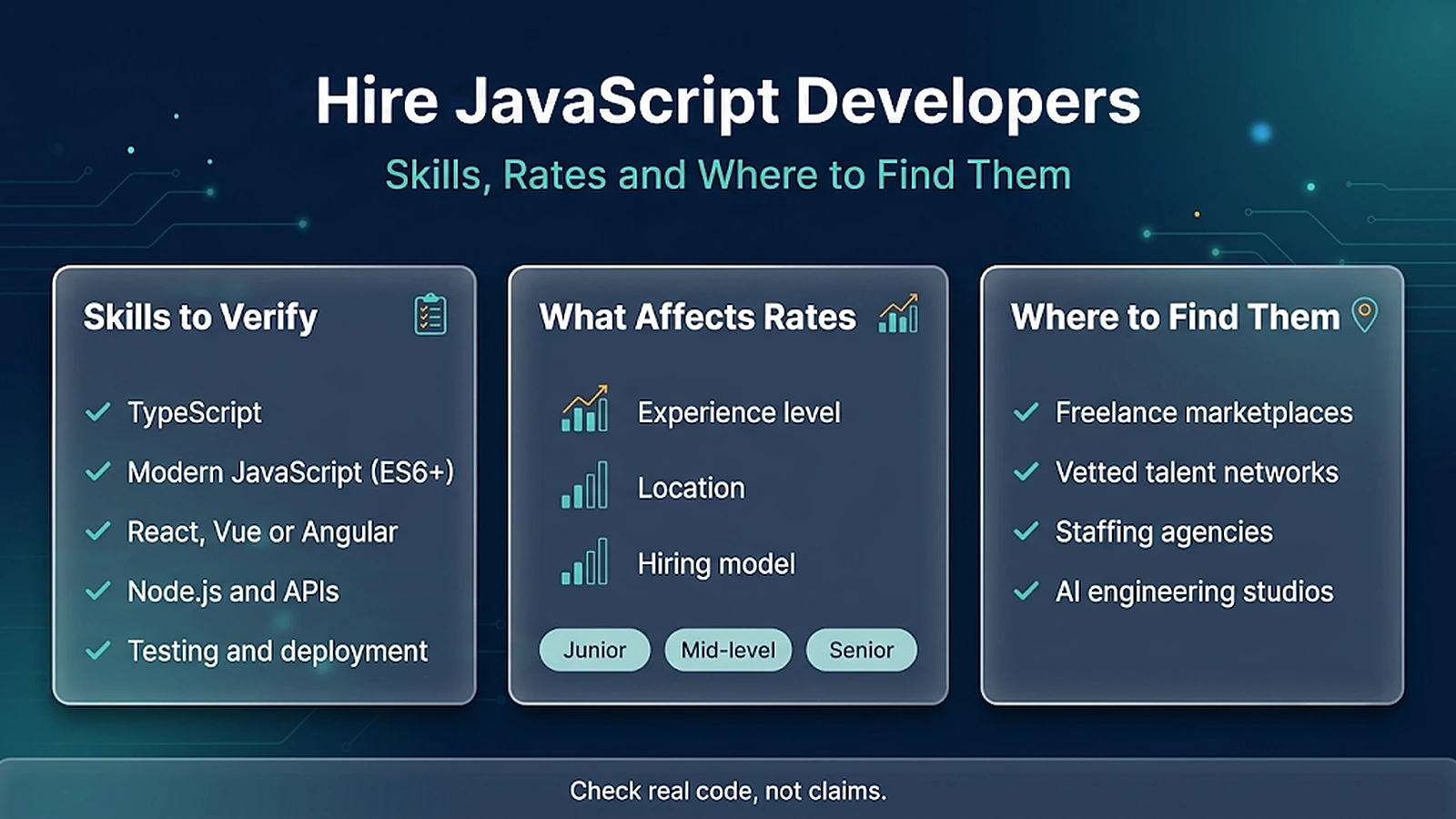
JavaScript experience can range from basic scripts to building and deploying complex applications. Before you hire JavaScript developer candidates, check their TypeScript skills, framework knowledge, testing experience and production work. Rates also vary by skill level, location, and hiring model.
Introduction
JavaScript is one of the most widely used languages in web development. This also makes hiring harder. Almost every developer may list it on their resume, but their experience can vary widely. Some have built basic scripts, while others have delivered React applications, Node.js backends, and AI-powered products.
At Quantal AI, we recommend a clear evaluation process before a JavaScript developer hires. It helps businesses identify the right skills, set a fair budget, and avoid hiring based on claims alone.
Key Takeaways
- Define the role before you hire JavaScript developer candidates.
- Check TypeScript, modern JavaScript, frameworks, testing, and deployment skills.
- Senior developers should have experience with production systems.
- Freelance rates can range from $40 to $150 per hour, based on the supplied 2026 benchmark.
- The right hiring choice depends on project scope, technical needs, and long-term plans.
DEFINITION BOXES
What Is a JavaScript Developer?
A JavaScript developer writes code in JavaScript, the primary programming language of the web. They build interactive frontends, server-side backends, full-stack applications, and AI-integrated web products. Their expertise can range from frontend development using React or Vue to full-stack engineering with Node.js and modern frontend frameworks.
What Is the Difference Between a Junior and Senior JavaScript Developer?
A junior JavaScript developer can write basic scripts, build simple UI components, and follow existing code patterns. A senior JavaScript developer handles architecture, writes TypeScript, builds production systems, creates testing strategies, and works independently across complex codebases. This experience is especially important for outsourced and remote development projects.
What Is TypeScript and Why Does It Matter?
TypeScript is a typed superset of JavaScript that compiles into plain JavaScript. It adds static type checking, which helps catch errors before runtime and makes code easier to maintain. It is widely used in modern production JavaScript projects. Developers without TypeScript experience may struggle to work effectively with complex codebases and current engineering practices.
The JavaScript Skills Range Problem - Why Hiring Is Harder Than It Looks
The term JavaScript developer covers a wide range of skills. A person who has built a simple website may have very different abilities from someone who has managed a large application.
| What They Cannot Do | Level | What They Can Do |
| TypeScript, state management, API integration, testing | Entry Level | Basic DOM manipulation, simple React components, tutorial projects |
| Complex architecture, performance optimization, microservices | Mid-Level | React or Vue frontend, REST API integration, basic Node.js |
| Nothing at this level — they are production-ready | Senior | TypeScript, full-stack JS, system design, testing, cloud deployment |
| Rarely found on general platforms | Specialist | AI-integrated JS, LangChain.js, OpenAI SDK, real-time systems |
Rates are indicative figures from the supplied 2026 brief, not independently verified market averages.
A hiring mistake often starts when the role is not clearly defined. Before you hire JavaScript developer candidates, list the frameworks, tasks and production needs of the project. This makes it easier to judge whether a candidate is suitable.
Core JavaScript Skills to Verify Before You Hire
The skills you assess should match the part of the application the developer will manage. However, some skills matter across most production roles.
JavaScript Developer Skills Checklist:
| Skill Area | What to Look For | Red Flag |
| TypeScript | Type-safe development — interfaces, generics, strict mode across the codebase | Writes only JavaScript — no TypeScript experience in 2026 |
| Modern JavaScript — ES6 Plus | Arrow functions, destructuring, async/await, modules, optional chaining | Uses only var and callback patterns — not updated to modern JS |
| Frontend Frameworks | React, Vue or Angular — production application experience with one framework | Only knows tutorial-level components — no real app experience |
| State Management | Redux, Zustand, Recoil or Vue Pinia for complex application state | Cannot manage state beyond local component state |
| Node.js and Backend JS | Express.js or NestJS for full-stack or backend-capable developers | No backend JavaScript experience for full-stack roles |
| REST and GraphQL APIs | Designing and consuming APIs — authentication, error handling, rate limiting | Has only called APIs from tutorials — no production API experience |
| Testing | Jest for unit tests, React Testing Library for components, Cypress for E2E | Has never written a test in JavaScript |
| Git and Code Review | Pull requests, branching strategies, code review participation | Works without version control or code review processes |
| Performance Optimization | Bundle size management, lazy loading, Core Web Vitals, Lighthouse scores | No awareness of JavaScript performance as a production concern |
| Cloud and Deployment | Vercel, AWS, Docker — production deployment experience | Has only deployed to localhost |
If your project needs a developer who can manage a large codebase, consider whether you should hire typescript developer talent rather than focus only on JavaScript. We also suggest checking real code samples and asking candidates to explain their technical choices.
For a wider hiring framework, read our guide on How to Hire AI Engineers and Developers.
JavaScript Developer Rates in 2026 - What to Expect
Hiring costs depend on the experience, location, and engagement model. The following figures are the estimates provided in the brief. Treat them as planning ranges and confirm current quotes before setting up a budget.
| Engagement Model | Junior | Mid-Level | Senior |
| Freelance — US hourly | $40 to $60 per hour | $60 to $100 per hour | $100 to $150 per hour |
| In-House — US annual salary | $82,460 per year | $135,980 per year median | Up to $214,670 per year |
| US Agency | $125 to $175 per hour | $150 to $200 per hour | $175 to $250 per hour |
| Nearshore — LATAM and Eastern Europe | 40 to 70 percent lower than US rates across all levels |
The salary figures in the brief are not a verified JavaScript-specific BLS salary series. The actual cost of an in-house hire also includes benefits, payroll taxes, and recruitment costs.
When comparing JavaScript development services, check what the quote includes. Some providers include project management and quality assurance, while others charge these separately. A lower hourly rate may also mean less experience with testing, system design, or production deployment.
Where to Find JavaScript Developers Worth Hiring
At Quantal AI, we recommend exploring these four options based on your project scope, budget, and hiring needs.
Freelance Marketplaces
Platforms like Upwork and Fiverr Pro offer access to JavaScript developers with visible portfolios, client reviews, and hourly rates. They work well for short-term or clearly defined tasks. However, screen candidates carefully because skill levels can vary.
Vetted Talent Networks
Toptal and Proxify pre-screen developers through technical assessments and multi-stage evaluations. They usually charge higher rates but reduce the screening effort for hiring managers.
Staffing and Recruitment Agencies
Companies like Insight Global and BridgeView handle candidate sourcing, screening, and placement. They are useful when you need a full-time JavaScript developer or a contract-to-hire arrangement.
AI Engineering Studios
Quantal AI provides pre-vetted JavaScript developers with verified frontend and backend production experience. Our dedicated, part-time, and project-based engagements are available within 24 hours. We cover standard JavaScript development services as well as AI-integrated application development. Also, you can read Hire Node JS Developers for Backend and AI-Integrated Applications.
Looking for pre-vetted JavaScript developers with verified production experience? See how Quantal AI matches engineers to your project → Hire AI Engineers
Engagement Models When You Hire JavaScript Developers
Choosing the right engagement model depends on your project scope, timeline, and need for ongoing support.
Freelance
When you hire freelance JavaScript developer talent through platforms like Upwork or Fiverr Pro, you get flexible support for specific components, bug fixes, or short-term features while managing the work directly.
Hire Dedicated JavaScript Developers
When you hire dedicated JavaScript developer talent through a specialist partner, you get a full-time engineer matched to your tech stack for ongoing product development and long-term ownership.
Remote JavaScript Developers
When you hire remote JavaScript developers, you can work with engineers across US and nearshore time zones. LATAM and Eastern European talent can offer cost advantages of 40% to 70% below US rates.
For more information about how to hire react developers you can read our guide on Hire React JS Developers: What to Look for When Outsourcing Frontend Work.
Ready to Hire JavaScript Developers for Your Project?
At Quantal AI, we are a New York-based AI engineering studio offering pre-vetted JavaScript developers with verified production experience in React, Node.js, TypeScript, and AI-integrated web applications. Our dedicated, part-time, and project-based engagements are available within 24 hours, backed by a 100% job success rate on Upwork. Whether you need a front-end developer, a full-stack engineer, or AI integration expertise, we match you with the right engineer for your technology stack.
Meet our Author

Shailesh Jain
Co-Founder - Quantal AI