
- September 30, 2026
- Admin Quantal AI
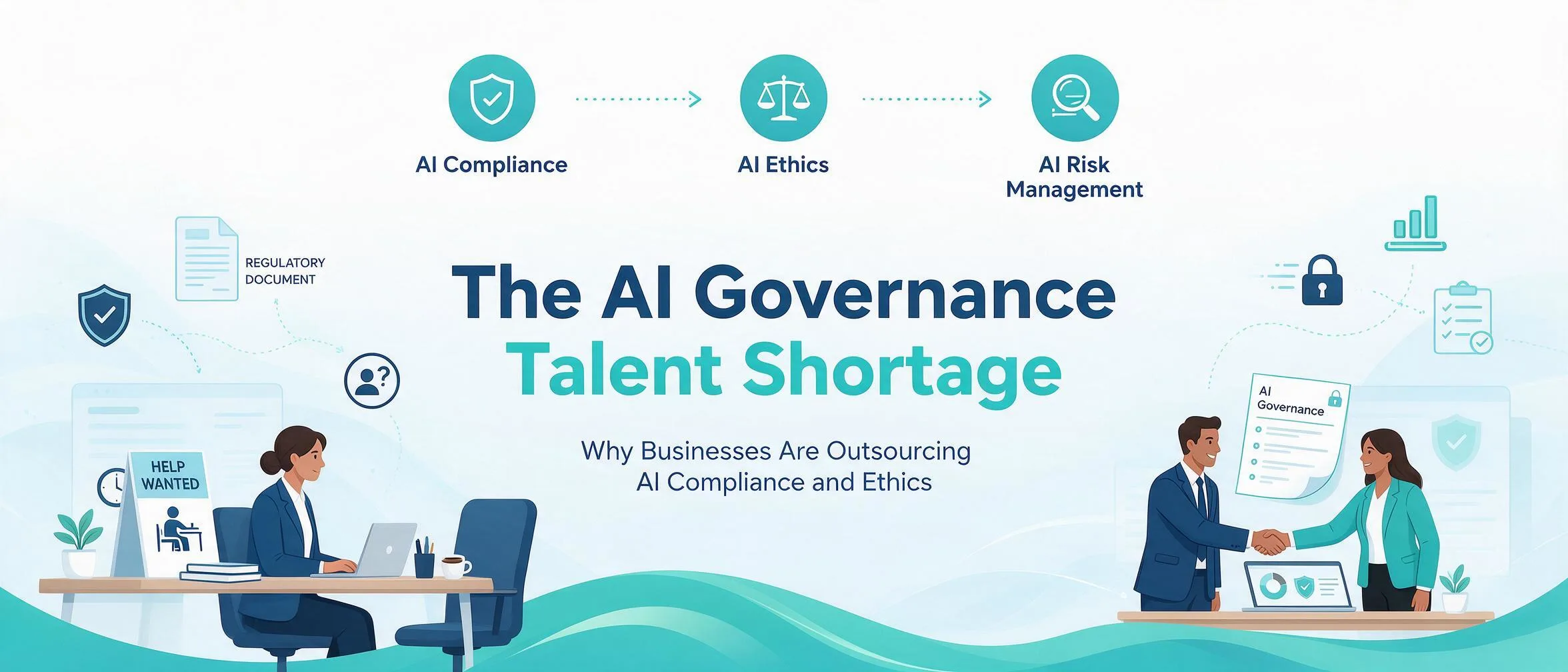
AI adoption is growing across healthcare, finance, retail, and manufacturing. Businesses are building AI assistants, automation tools, and decision-support systems faster than ever. At the same time, they face a new challenge. Finding people who can manage AI governance has become difficult.
The AI governance talent shortage goes beyond hiring engineers. Companies also need experts who understand AI risk, compliance, ethics, and governance frameworks. These roles are becoming harder to fill as regulations grow, and AI systems become more complex.
Instead of building every capability in-house, many organizations now work with external specialists. This helps them strengthen compliance while keeping AI projects moving.
Key Takeaways
- The AI governance talent shortage is affecting companies across multiple industries.
- Governance requires skills in compliance, ethics, risk management, and AI oversight.
- Outsourcing helps businesses access specialist knowledge without long hiring cycles.
- AI governance should be planned alongside AI development, not after deployment.
- A structured governance approach can support both compliance and business growth.
Why the AI Governance Talent Shortage Is Growing
AI adoption has increased much faster than the supply of experienced governance professionals.
Companies need people who understand AI regulations, responsible AI practices, and internal governance processes. They also need experts who can work with technical teams and business leaders at the same time.
The World Economic Forum's Future of Jobs Report 2025 identifies AI and big data as the fastest-growing skill area through 2030. This growing demand has increased competition for experienced AI professionals across industries.
The shortage is not limited to software companies.
Organizations in healthcare, finance, insurance, logistics, and manufacturing are all looking for governance expertise.
This broader AI talent shortage is one reason many companies are reconsidering how they build AI teams. Quantal AI explores this wider workforce challenge in its guide on AI talent shortages.
Why AI Governance Is More Than Compliance
Some businesses treat governance as a legal checklist. In practice, governance is much broader.
A governance team may help answer questions such as:
- Is the AI system using data responsibly?
- Who approves high-risk AI decisions?
- How are models monitored after deployment?
- What happens when an AI system makes an unexpected decision?
- How should customer data be protected?
These responsibilities often involve legal teams, engineering teams, security teams, and business leaders working together. The challenge becomes bigger because of the growing AI compliance talent gap. Organizations need professionals who understand both technical systems and regulatory expectations.
Who Handles AI Governance in a Company?
Many business leaders ask, who handles AI governance in a company? The answer depends on the organization's size and AI maturity. Smaller businesses may assign governance responsibilities to existing leaders.
Larger organizations often create dedicated governance structures.
A governance team may include:
- Compliance leaders
- Legal teams
- Security specialists
- Data governance professionals
- AI risk managers
- Technical AI leaders
- Executive sponsors
The important point is clear ownership.
Without defined ownership, governance decisions can become inconsistent.
This is one reason AI governance roles are becoming more important as AI adoption grows.
Why AI Compliance Is Becoming Harder
AI systems now operate across many business functions. It creates more oversight requirements.
Organizations must think about:
- Data privacy
- Model transparency
- Risk management
- Human oversight
- Documentation
- Monitoring
- Security
- Regulatory expectations
For businesses working across different markets, these requirements become even more complex.
The EU AI Act is one example of a regulatory framework that introduces risk-based obligations for certain AI systems.
Businesses serving international markets should understand how these rules may affect future AI projects. The growing AI compliance professionals shortage is also making it harder for businesses to keep pace with changing regulations, which is why understanding the EU AI Act has become an important part of AI governance planning.
Why Businesses Are Outsourcing Governance Expertise
Many organizations do not need a large internal governance department immediately. They do need access to experienced guidance. This is why outsourcing has become a practical option.
External specialists can help businesses:
- Build governance frameworks
- Review AI risks
- Improve compliance processes
- Support technical teams
- Create documentation
- Prepare governance workflows
- Strengthen deployment planning
This approach helps companies reduce delays caused by the AI compliance talent gap.
Instead of waiting months to hire specialists, businesses can begin improving governance earlier.
In-House Vs Outsourced AI Governance
The right approach depends on the business. Some companies build internal governance teams. Others combine internal ownership with external expertise.
| Area | In-House Governance | Outsourced Governance |
|---|---|---|
| Hiring time | Often longer | Faster access to specialists |
| Specialized expertise | Limited by hiring market | Wider governance experience |
| Scalability | Depends on team size | Flexible support |
| Regulatory guidance | Internal resources | Broader external experience |
| Cost flexibility | Fixed staffing costs | Project-based support |
Many organizations choose a hybrid approach. Internal teams retain decision-making responsibility, while external experts help strengthen governance processes. This can be especially useful during periods of rapid AI adoption.
Why Ethics Is Becoming Part of AI Governance
Governance is not only about regulations. It also includes responsible decision-making. The growing AI ethics talent shortage reflects this challenge.
Organizations increasingly need people who can consider:
- Fairness
- Transparency
- Accountability
- Human oversight
- Risk management
- Responsible AI practices
These discussions often happen alongside product development. Waiting until deployment can make governance harder. Businesses building production of AI systems often benefit from combining governance planning with AI engineering services so that technical decisions and governance requirements develop together.
Building Governance into AI Projects Early
Governance works best when it starts before deployment.
Business leaders can strengthen AI projects by asking a few practical questions early.
- What business problem is the AI solving?
- What data will it use?
- Who approves high-risk decisions?
- How will performance be monitored?
- What documentation will be required?
- Who owns governance after launch?
These questions help create clearer ownership. They also reduce confusion later. Strong governance should become part of the project lifecycle rather than a separate approval step.
Build AI Governance That Can Grow with Your Business
The AI governance talent shortage is changing how businesses approach AI adoption.
Organizations now need expertise that combines compliance, ethics, risk management, and technical understanding. As regulations become more detailed, relying only on traditional hiring may not provide the flexibility businesses need.
A balanced approach can help. Internal ownership creates accountability, while external specialists provide experience that may not be available in-house.
For businesses looking to hire AI engineers who understand both technical delivery and governance requirements, working with an experienced AI engineering partner can help bridge this gap
Quantal AI helps organizations build production-ready AI systems while supporting responsible AI implementation through engineering, automation, and governance-aware delivery practices. Their approach focuses on planning governance alongside architecture, development, deployment, and ongoing optimization.
Businesses that want to strengthen governance without slowing AI adoption can explore how Quantal AI supports practical AI implementation for enterprise projects.