- July 23, 2026
- Admin Quantal AI
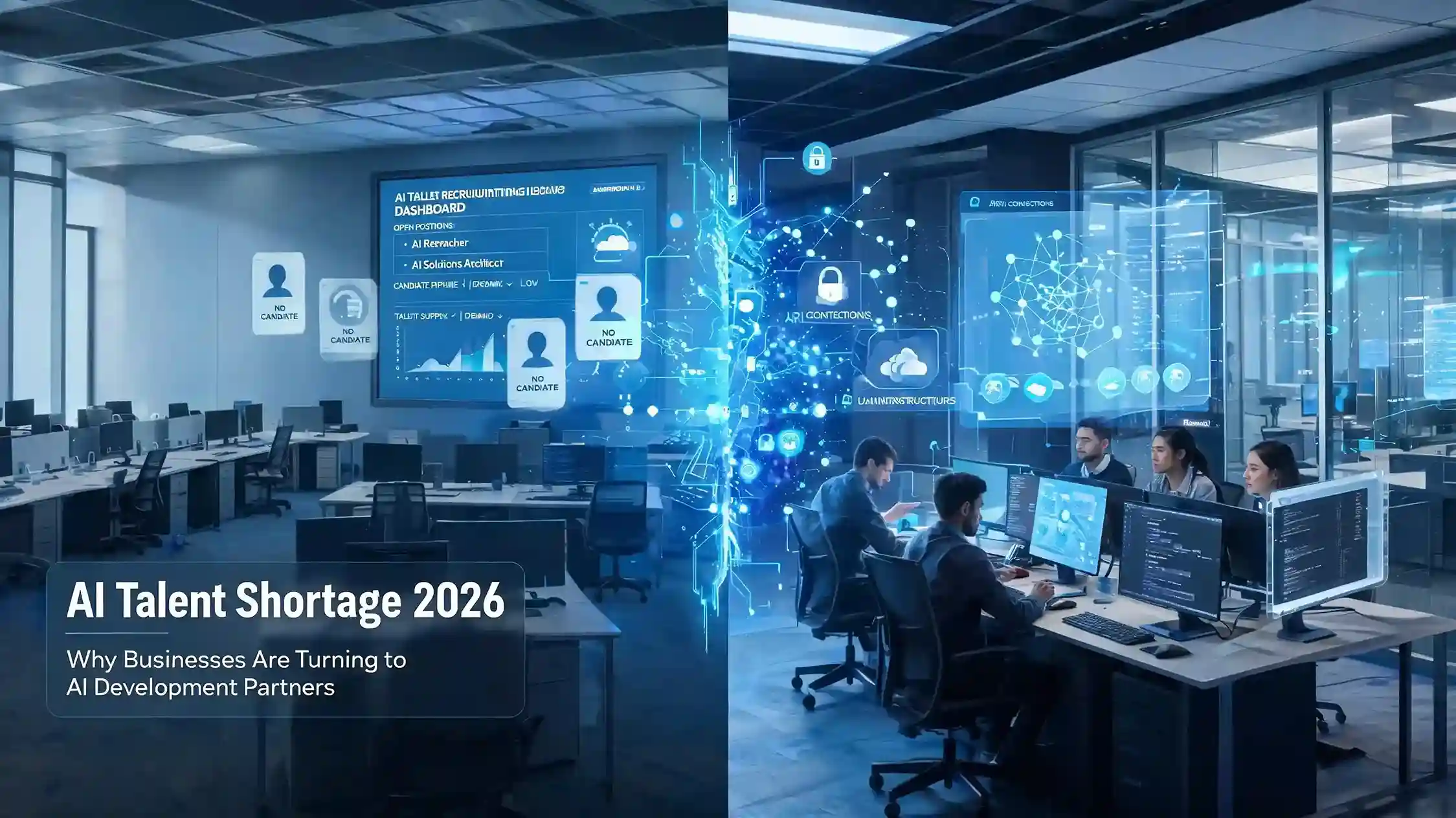
Artificial intelligence (AI) has moved beyond experimentation. Businesses across industries are integrating AI into customer service, software development, marketing, operations, and decision-making. However, one challenge continues to slow AI adoption: finding the right talent.
The AI talent shortage has become a major concern for organizations in 2026. Demand for AI engineers, machine learning specialists, and data scientists is growing much faster than the available workforce. As a result, companies are facing longer hiring cycles, higher recruitment costs, and increased competition for experienced professionals.
According to the World Economic Forum's Future of Jobs Report 2025, demand for AI and big data skills continues to grow rapidly, making AI-related roles among the fastest-growing job categories worldwide. The same report found that 70% of organizations plan to hire people with new AI-related skills by 2030, even as qualified candidates remain in short supply. This imbalance between demand and available talent is widening the AI skills gap across every major industry.
Rather than waiting months to build an internal AI team, many organizations are embracing artificial intelligence outsourcing to access experienced professionals, accelerate development, and reduce hiring risks. Working with trusted AI development partners allows businesses to focus on innovation while gaining immediate access to specialized expertise.
Key Takeaways
- The AI talent shortage is making it increasingly difficult for businesses to recruit experienced AI professionals.
- The growing AI skills gap is driving organizations to explore flexible hiring strategies.
- Artificial intelligence outsourcing provides faster access to specialized AI expertise without lengthy recruitment processes.
- AI development partners help businesses reduce hiring costs, speed up project delivery, and scale teams as businesses need to evolve.
- Organizations are increasingly combining in-house talent with external AI specialists to stay competitive in a rapidly changing market.
Why the AI Talent Shortage Is Getting Worse in 2026
AI adoption has accelerated over the past few years, fueled by advances in generative AI, automation, predictive analytics, and intelligent business applications. Companies no longer view AI as an experimental initiative; they see it as a business priority.
However, while demand has surged, the supply of experienced professionals has not kept pace.
Research from McKinsey's State of AI also highlights that organizations continue to expand AI adoption while reporting talent acquisition as one of their biggest implementation challenges. McKinsey also found that 75% of knowledge workers already use AI tools in some capacity, creating urgent demand for professionals who can build, deploy, and manage these systems at an enterprise level.
The scale of the challenge is significant. ManpowerGroup's 2026 Talent Shortage Survey of 39,000 employers across 41 countries found that 72% of businesses report difficulty filling roles with AI skills now ranking as the single hardest capability to hire for globally, surpassing traditional engineering and IT for the first time.
Several factors are contributing to today's AI talent shortage:
- Rapid enterprise adoption of AI technologies
- Increasing demand for generative AI and large language model (LLM) expertise
- Limited availability of professionals with real-world implementation experience
- Intense competition among businesses for experienced AI engineers
- Rising salary expectations for specialized AI roles
The challenge extends beyond hiring data scientists. Modern AI initiatives require expertise across multiple disciplines, including machine learning, cloud infrastructure, data engineering, MLOps (Machine Learning Operations, the practice of deploying, monitoring, and managing machine learning models in production), security, and governance.
Finding professionals who possess both technical knowledge and practical implementation experience has become increasingly difficult.
Understanding the Growing AI Skills Gap
The AI skills gap refers to the difference between the AI capabilities businesses need and the skills currently available in the workforce.
Many organizations already employ software developers and IT professionals. However, building enterprise AI solutions often requires specialized expertise that goes far beyond traditional software development.
For example, an enterprise AI project may require professionals who can:
- Develop and fine-tune machine learning models.
- Build secure AI applications using large language models.
- Design scalable cloud-based AI infrastructure.
- Integrate AI into existing enterprise systems.
- Monitor AI performance, compliance, and governance over time.
Upskilling existing employees is an important long-term strategy, but it takes time. Meanwhile, businesses still need to deliver AI initiatives on schedule.
As a result, many organizations are looking beyond conventional hiring and exploring more flexible workforce models to bridge the gap quickly. This shift has made external AI expertise an increasingly practical option for companies that need to move faster without compromising quality.
Why More Businesses Are Choosing AI Development Partners
Hiring an in-house AI team can take several months. Even after finding the right candidates, businesses must invest in onboarding, training, and long-term retention. For organizations working under tight deadlines, this approach may delay critical AI initiatives.
This is where AI outsourcing has become a practical business strategy.
By partnering with experienced AI development companies, businesses gain immediate access to specialists who have already delivered AI projects across industries. Instead of building every capability internally, organizations can supplement their existing teams with proven expertise.
Common benefits of outsourcing AI include:
- Faster project kickoff without extended recruitment cycles
- Access to specialists in machine learning, generative AI, MLOps, and cloud AI
- Lower hiring and operational costs
- Flexibility to scale teams as project requirements change
- Reduced risk through experienced implementation partners
Rather than replacing internal teams, AI development partners often work alongside existing employees to accelerate delivery while transferring knowledge throughout the project.
Looking to accelerate your AI initiatives without lengthy hiring cycles? We help businesses build scalable AI solutions with experienced specialists who integrate seamlessly into existing teams.
AI Staff Augmentation vs. Traditional Hiring
For many organizations, AI staff augmentation offers a balanced approach between hiring full-time employees and outsourcing an entire project.
Instead of recruiting permanent staff for every AI initiative, businesses can temporarily add experienced AI professionals to their existing development teams.
This model works especially well when companies need:
- Specialized AI expertise for a specific project
- Additional engineering capacity during peak workloads
- Faster delivery without expanding permanent headcount
- Access to emerging AI technologies that internal teams have limited experience with
Unlike conventional recruitment, AI staff augmentation allows organizations to remain agile while maintaining control over project direction and internal processes.
For organizations that need immediate engineering capacity, the ability to hire AI developer resources on a flexible basis without committing to permanent headcount has become one of the most practical solutions to the talent shortage.
In-House Hiring vs. AI Development Partners
| Factor | In-House AI Team | AI Development Partner |
| Hiring timeline | Often several months | Specialists available much faster |
| Recruitment costs | High | Lower upfront hiring costs |
| Access to specialized expertise | Limited to hired employees | Broad, multidisciplinary AI expertise |
| Scalability | Slower | Teams can scale up or down as needed |
| Project delivery | Dependent on hiring success | Faster implementation with experienced professionals |
| Long-term commitment | Full-time employment | Flexible engagement models |
For many businesses, the most effective strategy combines internal leadership with external AI specialists who can accelerate execution and reduce delivery risks.
Choosing the Right AI Development Partner
Not every AI partner offers the same level of expertise. At Quantal AI, we believe businesses should evaluate potential partners based on both technical capabilities and their ability to solve real business problems not just implementation speed.
When selecting an AI development partner, we recommend considering whether they:
- Have experience delivering enterprise AI solutions.
- Understand your industry and business objectives.
- Follow responsible AI and data security best practices.
- Offer flexible engagement models.
- Provide ongoing support after deployment.
- Can demonstrate measurable business outcomes through previous projects.
In our experience, a successful partnership goes beyond technical implementation. The right AI team should help align AI initiatives with long-term business goals while ensuring solutions remain scalable and maintainable over time.
Building AI Capability Without Slowing Innovation
The AI talent shortage is unlikely to disappear anytime soon. As AI adoption continues to grow, competition for experienced professionals will remain intense.
Rather than delaying innovation while searching for hard-to-find talent, we recommend organizations explore artificial intelligence outsourcing and AI staff augmentation to gain immediate access to experienced AI professionals. These approaches help businesses move faster, reduce hiring challenges, and keep AI initiatives on track without compromising quality.
At Quantal AI, we help organizations build and scale AI solutions with experienced specialists who understand both technology and business outcomes. Whether you're looking to hire AI expert for your next initiative, our team can help you accelerate AI adoption with confidence.