
- September 28, 2026
- Admin Quantal AI
As the focus on conversational AI becomes increasingly saturated, AI is pivoting toward agentic AI, which can make plans, invoke toolsets, and send messages to other applications. This opens new markets and development avenues in the business world but also raises fears about safety, accountability, and regulation.
As adoption grows, agentic AI compliance requirements in 2026 are becoming an important consideration for business leaders planning to deploy autonomous or semi-autonomous AI systems. The right approach depends on what the agent does, what information it can access, and how much authority it has.
Businesses evaluating this technology should first understand what agentic AI is and how it works before assessing the controls needed for safe and compliant deployment.
Key Takeaways
- Agentic AI needs stricter controls as AI agents can decide and act.
- Compliance varies with the agent’s purpose, risk, data access, and environment.
- Human oversight, audit trails and clear permissions are important governance controls
- The EU AI Act and NIST AI RMF provide useful foundations for managing AI risks
- Compliance should be considered during AI development, not added after deployment
What makes agentic AI compliance different from traditional AI?
Traditional AI applications respond to user requests with outputs. An AI agent can go further by planning actions, using external tools, retrieving information, or modifying connected systems.
This difference makes agentic AI compliance more complex. A business needs to consider not only whether an AI model produces accurate outputs, but also what the agent can do with those outputs.
Key considerations include:
- What systems and tools the agent can access
- Which actions it can perform without approval
- What business or personal data it can process
- How decisions and actions are recorded
- When a human must intervene
The more autonomy and access an agent have, the more important these controls become.
What are the key agentic AI compliance requirements in 2026?
No single checklist applies to every AI agent. However, agentic AI governance requirements generally need to address several core areas.
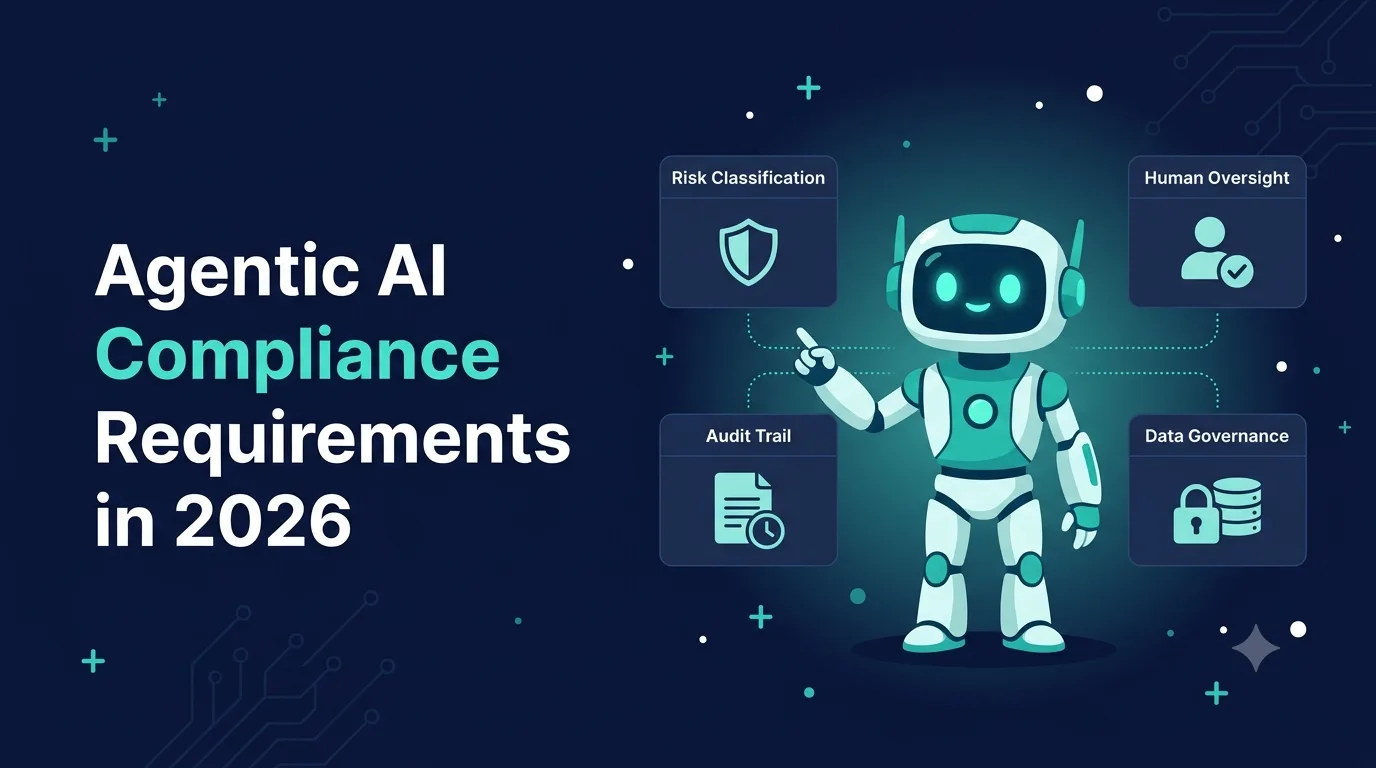
| Compliance Area | What Businesses Should Consider |
|---|---|
| Risk classification | Identify the potential impact of the agent and its intended use |
| Human oversight | Define when human review, approval or intervention is required |
| Transparency | Make the agent’s role, capabilities and limitations clear |
| Audit trails | Record important decisions, actions, tool calls and interventions |
| Data governance | Control data access, processing, retention and permissions |
| Security | Protect connected systems, APIs, credentials and agent workflows |
These controls form an important foundation for agentic AI compliance requirements in 2026, particularly when agents are used in sensitive business processes.
Businesses should also consider agentic AI risk classification before deployment. An internal productivity agent that summarizes documents poses different risks than one approving financial transaction or affecting individuals.
How does the EU AI act apply to AI agents in 2026?
The EU AI Act does not create one blanket category for “AI agents”. Instead, requirements depend on factors such as the system’s intended purpose, role, and risk classification.
For businesses using agents in Europe, EU AI Act agentic AI requirements may therefore vary according to the system being developed or deployed. The AI Act follows a risk-based approach, while transparency obligations under Article 50 apply from 2 August 2026.
The Act requires providers of general-purpose AI models to include technical documentation, copyright policies, and training content summaries, with extra rules for GPAI models with systemic risks.
This makes the EU AI Act high-risk AI systems in 2026 an important area for businesses to review when an agent forms part of a regulated or high-impact application.
For a broader regulatory overview, businesses can also refer to the EU AI Act requirements for AI product builders.
What human oversight and audit controls should AI agents have?
1. Human Oversight
Consider agentic AI human oversight requirements based on the agent’s risk and level of autonomy. Businesses can establish approval points for actions that could create financial, legal, operational, or reputational consequences.
Useful controls can include:
- Human approval before high-impact actions
- Clear escalation rules
- The ability to pause or stop an agent
- Defined limits on autonomous decisions
- Assignment of responsibility for reviewing agent activity
Human oversight should be practical, not just a policy document.
2. Audit Trails
Agentic AI audit trail requirements are equally important when agents can interact with business systems. Logs can help organizations understand what happens when an agent makes an unexpected decision.
Depending on the use case, businesses may record:
- User instructions and relevant inputs
- Agent decisions and actions
- Tool and API calls
- Human approvals or interventions
- Errors, exceptions and failed actions
A reliable audit trail can support monitoring, incident investigation, and ongoing governance.
How can NIST AI RMF support agentic AI governance?
The NIST AI Risk Management Framework provides a voluntary, risk-driven approach for organizations dealing with AI. Its main functions — Govern, Map, Measure, and Manage — assist in handling risks associated with AI agents.
The NIST AI RMF agentic AI approach can help map the agent’s intended role, identify risks, measure system performance, and manage issues throughout its lifecycle.
NIST is also developing initiatives specifically focused on AI agents and standards for trusted, secure, and interoperable agentic systems.
What should businesses check before deploying an AI agent?
Before moving an agent into production, business leaders should review more than model performance. A practical assessment can include:
- Define the agent’s purpose, scope and permitted actions
- Identify the systems and data it can access
- Establish user permissions and approval requirements
- Complete an appropriate AI agent compliance 2026 assessment
- Test failure, misuse and security scenarios
- Implement monitoring and audit logging
- Review applicable regulatory requirements
- Reassess the agent when its capabilities or connected systems change
This approach helps organizations treat compliance as an ongoing process rather than one-time approval.
Why should compliance be built into agentic AI development?
Managing compliance is easier with governance controls during architecture and development. Adding permissions, monitoring, checkpoints, and logging after deployment is difficult, especially when an agent connects to critical systems.
Strong agentic AI governance requirements can therefore be built into development through controlled tool access, defined workflows, testing, monitoring and documented decision rules.
This is especially relevant as businesses use agents for AI workflow automation, where autonomous actions can directly affect operational processes. Organizations also need access to people who understand both AI engineering and governance, particularly as the growing shortage of AI governance professionals create additional implementation challenges.
Building compliant AI agents for business
AI agents automate tasks, synchronize operations, and increase AI applicability in day-to-day work. The greater the autonomy the business has to relinquish. Businesses need to understand what the AI agent can access, what decisions it will make, and when humans must step in to monitor, check, or stop operations.
A practical compliance strategy combines risk assessment, safeguards, transparency, and governance. Review regulatory requirements with the agent’s purpose and environment, not separately.
Quantal AI empowers organizations to develop and integrate AI strategies and solutions pertaining to architecture, governance, automation, and ethical deployment. Its competencies provide the experience needed to evaluate agentic systems and design solutions that translate technological prowess into Business and compliance needs.
For organizations planning their next AI initiative, an experienced agentic AI development company can help build compliant AI agents for business while keeping scalability, security and governance in view.