
- September 30, 2026
- Admin Quantal AI
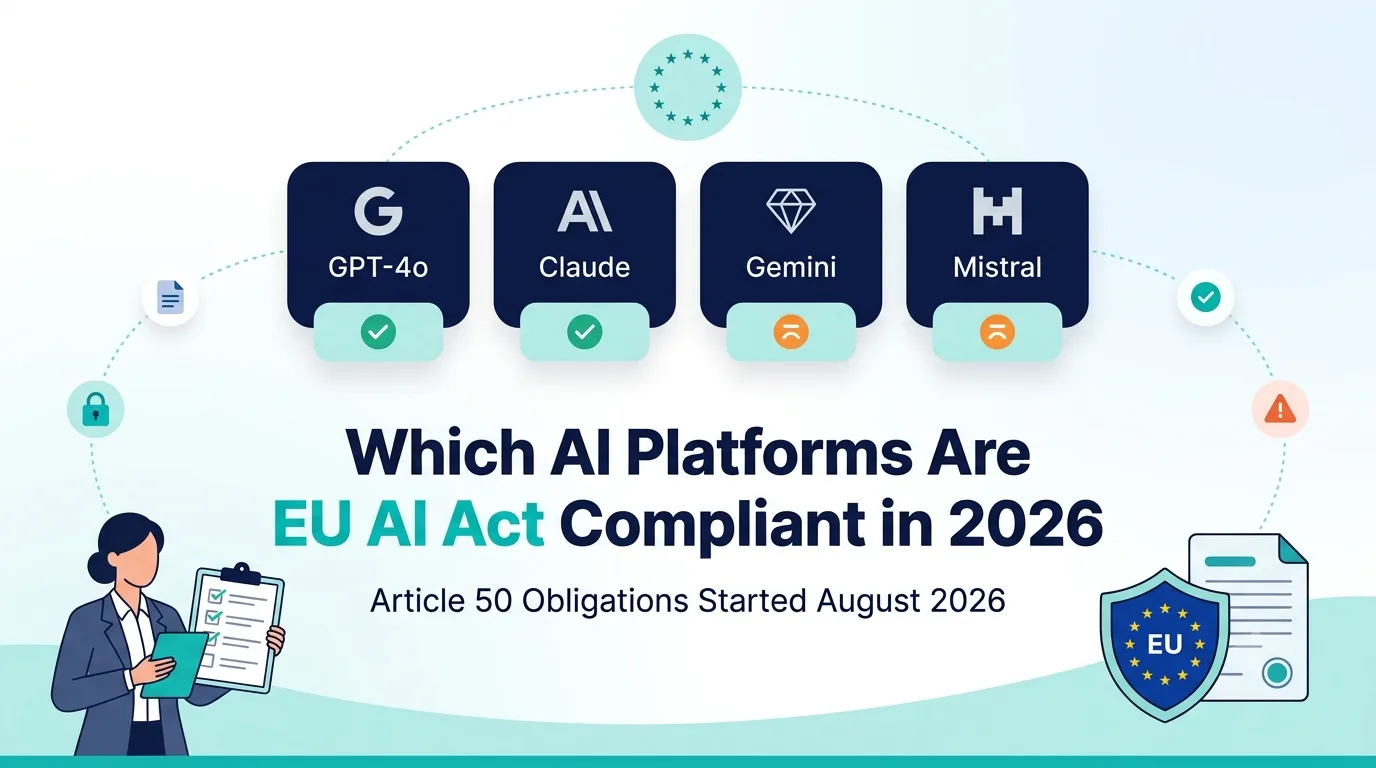
The EU AI Act impacts businesses using generative AI in Europe. By 2026, companies will evaluate AI platforms for transparency, data governance, and compliance, alongside accuracy, speed, and cost.
Determining platform compliance isn't just about checking for a badge. Requirements vary by AI model type, deployment method, provider, and system purpose. This makes evaluating EU AI Act compliant generative AI platforms more nuanced than simply choosing a well-known AI provider.
For a full breakdown of what the EU AI Act requires, read our EU AI Act compliance guide.
Key Takeaways
- EU AI Act compliance depends on the AI model, deployment, provider and intended use
- OpenAI, Anthropic, Google, and Mistral have introduced measures satisfying EU AI Act requirements.
- Article 50 transparency obligations started applying from 2 August 2026
- EU data residency supports governance but doesn't ensure AI Act compliance.
- US companies may fall under the EU AI Act based on how they use their AI systems or place them on the EU market.
What does EU AI Act compliance mean for generative AI platforms?
The EU AI Act mandates technical documentation, copyright compliance, and disclosure of training data for general-purpose models, and imposes additional requirements like risk assessments, incident reporting, and cybersecurity for systemic risk models.
For businesses, this creates an important distinction between provider compliance and deployment compliance.
An AI provider may meet model obligations, but a business using that model in its product might have separate responsibilities. These depend on:
- The intended purpose of the AI system
- How the model is integrated
- Whether people interact directly with AI
- Whether the system generates or manipulates content
- What type of data is processed
This means that EU AI Act-compliant generative AI platforms should be assessed as part of the complete AI implementation rather than in isolation.
Which AI platforms are EU AI Act compliant in 2026?
No EU-approved list labels GPT-4o, Claude, Gemini, or Mistral as compliant. Businesses should review provider docs, governance, and their use case needs.
| AI Platform | What Businesses Should Review |
|---|---|
| OpenAI GPT-4o | AI Act guidance, model documentation, training-data information and customer responsibilities |
| Anthropic Claude | Model documentation, transparency measures and deployment requirements |
| Google Gemini | Transparency measures, content provenance and applicable AI governance controls |
| Mistral AI | AI governance documentation, model information and transparency requirements |
Is OpenAI GPT-4o EU AI Act compliant?
OpenAI is committed to developing models that meet EU AI Act requirements. It offers resources to help customers understand their obligations and has published info on general-purpose AI models.
Therefore, the answer to is OpenAI GPT4o EU AI Act compliant depends partly on the application being built with the model. Using GPT-4o does not automatically make the final AI system compliant.
Is anthropic Claude EU AI Act compliant?
Anthropic announced in August 2026 that future Claude models would use text watermarking to comply with the EU AI Act, focusing on AI-generated content transparency.
So, is the Anthropic Claude EU AI Act compliant? Anthropic is taking steps to address applicable requirements, but businesses still need to assess their own Claude deployment and responsibilities.
Is google Gemini EU AI Act compliant?
Google signed the EU AI Act Code of Practice on Transparency of AI-Generated Content in July 2026. It also uses technologies such as SynthID and supports the C2PA standard as part of its broader content provenance efforts.
This provides useful transparency measures for Gemini users but is google Gemini EU AI Act compliant cannot be answered independently of the system and use case.
Is mistral AI EU AI Act compliant?
Mistral AI maintains a dedicated AI governance hub with model and AI-system documentation covering the EU AI Act. Its documentation explains which obligations can apply to specific models and systems.
Therefore, is mistral AI EU AI act compliant depends on the specific model, service and deployment being assessed.
What are the EU AI Act transparency obligations in 2026?
One of the most important developments under the EU AI Act 2026 is the application of Article 50.
The EU AI Act transparency obligations under Article 50 began on 2 August 2026 to help people recognize AI interactions and generated content.
Depending on the system, requirements can include:
- Informing people when they are directly interacting with AI
- Applying machine-readable markings to certain AI-generated or manipulated content
- Labelling certain deepfakes
- Providing appropriate disclosures for specific AI-generated content
The EU AI Act Article 50 requirements therefore matter to both AI providers and organizations deploying AI systems.
A transition period applies to some AI systems on the market before August 2, 2026. For AI-generated content marking and detection, the deadline extends to December 2, 2026.
Does EU AI Act data residency determine compliance?
EU AI Act data residency is an important consideration for businesses handling sensitive or regulated information, but EU-based hosting does not automatically make an AI system compliant.
Businesses should look beyond the physical location of their data and assess:
- Where data is stored and processed
- Whether customer data is used for model training
- Which sub processors are involved
- Data retention and deletion controls
- Access and security measures
- Contractual protections
Consider these checks alongside GDPR and other applicable privacy requirements.
Does the EU AI Act apply to US companies?
Yes, potentially.
The EU AI Act applies to non-EU organizations when they place covered AI systems or models on the EU market or use them in regulated circumstances. It can also apply to some external providers if their AI output is used in the EU.
So, does the EU AI Act apply to US companies? A company's location alone does not determine whether the regulation applies.
US businesses should consider:
- Whether they provide AI systems to EU users
- Whether their AI model is placed on the EU market
- Where the AI system is used
- Whether its outputs are used in the EU
How do I know if my AI platform is EU AI Act compliant?
If you are asking, how do I know if my AI platform is EU AI Act compliant, use a structured assessment rather than relying on a provider's general compliance statement.
1. Identify the model and system
Determine whether you are using a general-purpose AI model, an AI application, or a combination of multiple technologies.
2. Define the intended use
The same model can have different regulatory implications depending on how it is integrated and what the final system does.
3. Review provider documentation
Check model documentation, training data information, governance policies, safety measures, and transparency capabilities.
4. Assess Article 50 requirements
Determine whether the application needs AI interaction disclosures, content marking, or other transparency measures.
5. Check your own responsibilities
A provider's compliance measures do not necessarily cover every obligation of the organization deploying the AI system.
6. Review data and security controls
Assess processing locations, access controls, retention policies, sub processors and other relevant governance measures.
This is more reliable than simply searching for which generative AI tools comply with the EU AI Act and choosing a platform based on a broad compliance claim.
How does EU AI Act compliance affect AI development?
EU requirements can influence how AI systems are designed, documented, tested, and deployed. EU AI Act compliant AI development may involve model documentation, transparency controls, risk assessment, human oversight and appropriate safeguards based on the AI system’s role.
Businesses developing AI applications should consider:
- Model and system documentation
- Data governance
- Transparency mechanisms
- Human oversight where applicable
- Monitoring and risk controls
- Security and access management
When ML models are part of a larger AI product, these requirements must be considered with performance and deployment needs. Businesses can use AI/ML services when they need technical support to develop and integrate machine learning systems with these considerations in mind.
Building AI solutions for the European market
Choosing an AI platform is only one part of preparing an AI product for European users. Businesses also need to understand how the model fits into the final application, what data it handles, and which regulatory responsibilities apply to the system.
Quantal AI helps businesses develop and integrate AI and machine learning solutions with considerations around model governance, technical architecture, and regulatory requirements. Its AI engineering expertise can support businesses building, integrating or scaling AI applications across different use cases and markets.
Looking to build an AI solution for the European market? Hire AI engineers who understands EU compliance requirements.