
- September 29, 2026
- Admin Quantal AI
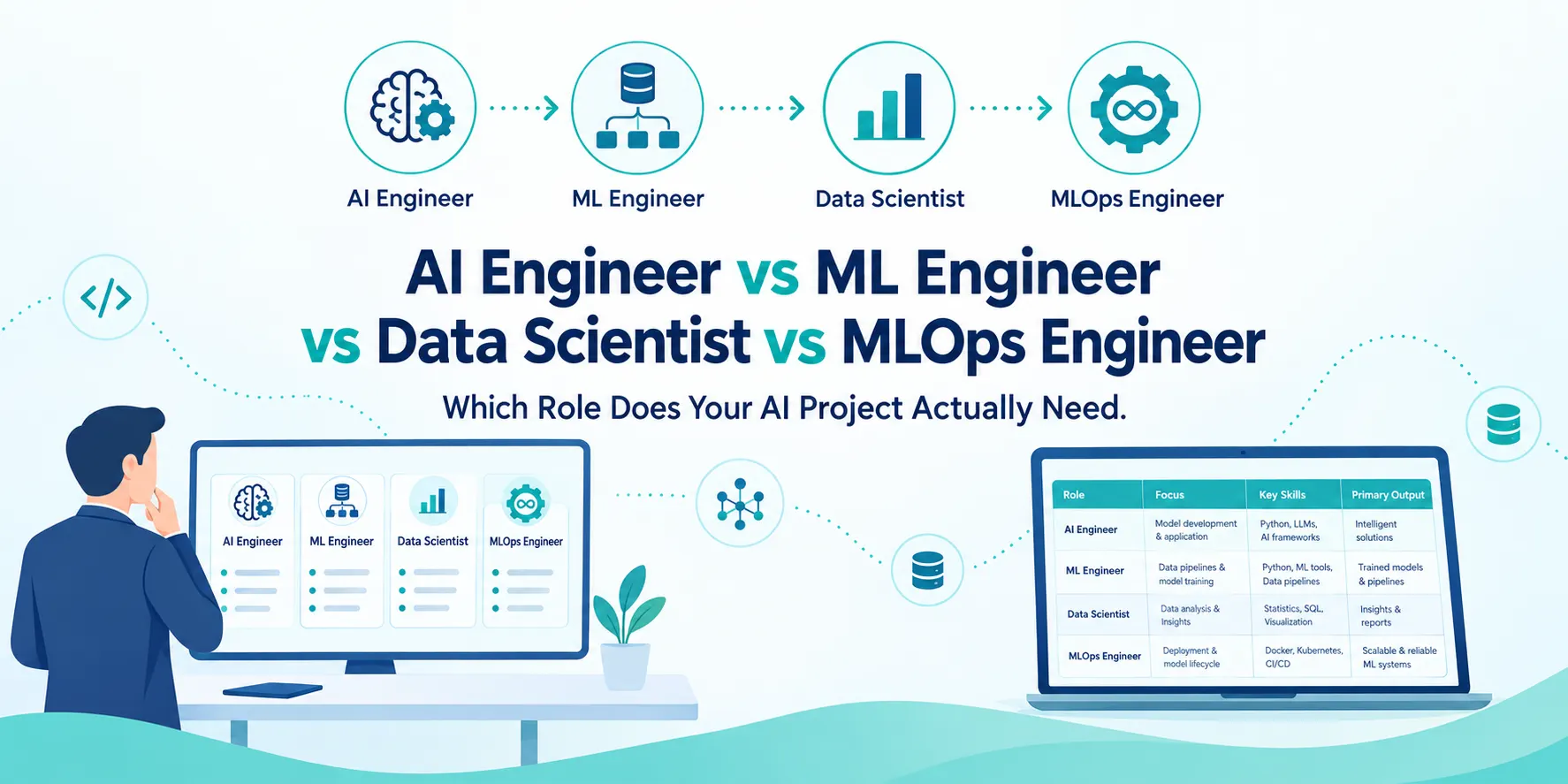
Choosing the right AI professional can be hard. Job titles often sound similar, but the work can be very different.
An AI engineer may build an AI-powered product. A machine learning engineer may develop and deploy ML models. A data scientist may study data and build models for business decisions. An MLOps engineer may make sure those models run well after deployment.
Understanding AI engineer vs ML engineer can help businesses make better hiring choices. It also helps teams know which skills they need at each stage of an AI project.
This guide breaks down these four roles in simple terms. It also explains when each specialist can add the most value.
Key Takeaways
- AI engineers build and connect AI features with software products.
- ML engineers focus on machine learning models and production systems.
- Data scientists work with data, analysis, and predictive models.
- MLOps engineers manage deployment, monitoring, and ML operations.
- The right role depends on your project goals, data, models, and production needs.
What Does Each AI Role Do?
The simplest way to understand these roles is to look at what each person owns.
An AI engineer builds AI systems that can work inside real products. Their work may include machine learning, natural language processing, computer vision, and generative AI.
An ML engineer focuses more on machine learning systems. They may train models, build data pipelines, and move models into production.
A data scientist works mainly with data. They look for patterns, test ideas, build models, and turn data into useful business insights.
An MLOps engineer works on the systems that support machine learning in production. MLOps means machine learning operations. It covers tasks such as deployment, monitoring, testing, and model updates.
For more technical detail, IBM’s overview of AI developers explains how AI development combines AI skills with software and system development.
AI Engineer Vs ML Engineer: How Are They Different?
The AI engineer vs ML engineer comparison can be confusing because both roles can work with machine learning.
The main difference is scope. AI engineers often work across the wider AI stack. They may connect models with APIs, databases, applications, and user-facing features.
ML engineers tend to focus more on machine learning models and their supporting systems.
The ML engineer vs AI engineer choice often comes down to the type of work your project needs.
| Role | Main Focus | Common Responsibilities |
| AI Engineer | AI applications | AI features, integrations, AI systems |
| ML Engineer | Machine learning | Models, pipelines, deployment |
| Data Scientist | Data and analysis | Research, analysis, prediction |
| MLOps Engineer | ML operations | Monitoring, automation, infrastructure |
The AI engineer vs software engineer comparison is also useful. Software engineers build software across many areas. AI engineers need additional knowledge of AI and machine learning systems.
AI Engineer Vs Data Scientist: Which One Do You Need?
The AI engineer vs data scientist question usually depends on the end goal.
A data scientist may start with a business problem and ask what the data can tell us. They may clean data, test models, and measure results.
An AI engineer may start with a product goal. They then work out how AI can become part of that product.
For example, imagine a bank wants to predict customer churn. A data scientist may study customer data and create a prediction model. An AI engineer may help turn that model into a feature inside the bank’s application.
This is why should I hire an AI engineer or data scientist does not always have one answer. Some projects need both. The AI engineer vs data scientist difference becomes clearer when you look at the final output. Data scientists often deliver analysis and models. AI engineers often deliver working AI systems.
ML Engineer Vs Data Scientist: Where Is the Difference?
The ML engineer vs data scientist distinction is often based on what happens after a model is created.
A data scientist may build and test a model to see whether it solves a problem. An ML engineer can take that model and prepare it for regular use.
The machine learning engineer vs data scientist difference can include:
- Model deployment
- Production data pipelines
- System performance
- Model scaling
- Software integration
- Automated testing
A data scientist may spend more time asking whether a model works. An ML engineer may spend more time making sure it works reliably at scale.
The data scientist vs machine learning engineer choice should therefore be based on the stage of your project.
What Does an MLOps Engineer Do?
So, what does an MLOps engineer do in a real AI team?
An MLOps engineer helps keep machine learning systems stable after they are built.
Their work may include:
- Deploying ML models
- Monitoring model performance
- Managing model versions
- Automating testing
- Building deployment pipelines
- Supporting retraining
- Managing cloud infrastructure
Google Cloud explains that MLOps helps teams manage the machine learning lifecycle from development through deployment and monitoring.
The MLOps engineer salary can vary based on experience, location, industry, and technical skills. A business should not choose this role based on salary alone.
The MLOps engineer salary may also differ from other AI roles because MLOps often requires knowledge of cloud systems, automation, security, and production infrastructure.
How Do These Four Roles Work Together?
The AI engineer vs ML engineer discussion becomes easier when you look at a typical project.
Imagine a company wanting to build an AI-powered customer support system.
- A data scientist may study customer data and find useful patterns
- An ML engineer may develop or improve the machine learning model
- An AI engineer may connect the AI system to the company’s software and customer interface
- An MLOps engineer may deploy the system and monitor how it performs
This does not mean every project need four separate people.
In a smaller team, one person may handle several responsibilities. Larger projects often need specialists for different parts of the system.
The ML engineer vs AI engineer decision also depends on how broad the AI work is. A focused ML system may need an ML engineer. A wider AI product may need an AI engineer.
Which Role Do I Need for My AI Project?
If you are asking which role, do I need for my AI project, start with the problem rather than the job title.
Choose A Data Scientist If:
- You need to explore large datasets
- You need statistical analysis
- You want to test business ideas
- You need predictive models
Choose An ML Engineer If:
- You already have ML models
- You need production-ready ML systems
- You need scalable model pipelines
- You need help deploying models
Choose An AI Engineer If:
- You are building an AI-powered product
- You need AI features added to existing software
- You need different AI tools connected together
- You need broader AI development skills
Choose An MLOps Engineer If:
- Your models are already in production
- You need automated deployment
- You need model monitoring
- You need reliable ML infrastructure
The data scientist vs ML engineer decision is especially important when moving from research to production.
Businesses can also explore AI engineering services when they need support across different parts of an AI system.
What Should Businesses Consider Before Hiring?
Before you hire AI engineer support, define the actual work first.
Ask these questions:
- Do we need to analyze data?
- Do we already have a machine learning model?
- Does the model need to go into production?
- Does the project need AI application development?
- Who will monitor the system after launch?
These questions can prevent a common hiring mistake: choosing a job title before defining the technical need.
The AI engineer vs software engineer choice matters when AI is a core part of the product. The machine learning engineer vs data scientist choice matters when the main need is either production ML or deeper data analysis.
Choosing The Right AI Specialist for Your Team
There is no single winner in the AI engineer vs data scientist debate. Each role has a different purpose.
The data scientist vs ML engineer choice depends on whether your priority is analysis or production machine learning. The ML engineer vs AI engineer choice depends on whether you need focused ML work or broader AI development.
MLOps become important when models need to run reliably in production. AI engineering becomes valuable when those capabilities need to become part of a real product.
Quantal AI takes a practical approach to building production-ready AI systems. They help businesses access AI engineering skills across areas such as machine learning, LLMs, AI agents, computer vision, and MLOps.
Businesses looking for specialist support can also hire AI engineers based on their project needs.